I was wandering around HEB today (I hate shopping without an appetite; it leads to a weird larder) and saw GARGANTUAN BONES for sale. There were weeny, teacup-Schnauzer sized bones (about twelve inches) and GOLIATH BONES (that was the name), so I bought a GOLIATH BONE.
Mongo took it from me with mingled excitement and trepidation. He chewed it for about ten minutes on the back deck, then walked around the back yard, stepping very carefully, with his head on one side as he carried it off-center in his mouth. He made sure Rocky next door and Gracie two yards over saw it, and plumed his tale out when the boxer mixes on the other side of Rocky began to bark.
He couldn't figure out where to hide it. There are two trees in the back yard: one is property of a cat, the other is a peach tree that, as yet, is not big enough to hide anything under. So he tried by the shed. Then he tried next to the deck. Then he tried by the bushes on the northwest side of the yard. Nothing worked.
So he brought his GOLIATH BONE indoors and, after a drink and a little toes-up on the living room rug, proceeded to look for a place to hide it inside. So far it's been in the bathroom, behind the toilet (no go; Humans peeing apparently are not conducive to a hiding place), in the office where I type (but he can't get to the couch at the moment, dammit), and in the linen closet. The linen closet is okay for now.
The previous three dogs I've been owned by were all either northern breeds or working breeds, or combinations of the two. That meant that Elsie would happily crunch the trochanter off a cow's femur, or Max would cheerfully, between tail-wags, chomp the bone in half at the middle, or Strider would simply make the damn thing disappear in under an hour. It was a short-lived, if dramatic, way to entertain a dog: buy them a bone much larger than anything in the human body, then wonder what would happen if I died in my sleep.
What Mongo lacks in barely-civilized, wolflike instinct he makes up for in entertainment value. I felt kind of bad for him as he pranced around the yard like a Tennessee walking horse, trying to keep The Bone from falling out of his mouth, but also amused by the fact that he grabbed it by the meatiest part rather than in the middle. And he's barely gotten two bumps chewed off since noon; this bodes well for the possibilities of an open casket funeral should I kick off during the night tonight.
Speaking of open caskets, I have started a BSN program (yes, my dears; I'm finally giving in to corporate pressure to have letters after my name) online. Tests are done with a webcam provided by the school; I have to be in sight of a proctor and with my entire workspace visible by same during the testing process.
So, I was wondering: is this the appropriate time to pull out the strapless ballgown, elbow-length gloves, and tiara I've been storing for a special occasion? I mean, my Psychology Through the Lifespan test is important; should I dress for the occasion? Would it be worth it to make the proctors crack a smile? Surely they could use a little levity in their jobs.
Mongo is yelping at one of the cats, who had the temerity to investigate His Bone. Gotta go.
Wednesday, March 16, 2016

Tuesday, March 08, 2016
There is a bloody bite block on my wall, just above my desk.
It's in a biohazard bag, don't worry. It's pinned to my wall, just above my desk, so that I can see it every single morning and remember why the hell I got into this crazy business in the first place.
We do a significant number of what are called transesophageal echocardiograms on our unit. Unlike transthoracic echoes, which take place when a tech holds an echo wand against your chest, a TEE takes place under moderate sedation, with a cardiologist feeding a long, skinny tube with an echo camera on the end of it down your throat.
You can't do this without sedation. Try, and you'll end up with a retching, fighting patient and a poor-quality image. It's just flat impossible to ask an alert human to stand for having a two-foot length of something the thickness of my index finger inserted down his or her throat and manipulated. So we sedate. We're a critical-care unit; we're all trained to administer sedation and recover patients who've been sedated.
Then, one day, Doctor deSade showed up. Dr. deS. was a new guy for us, from a different branch of cardiology, and nobody had worked with him before. The initial signs weren't promising: normally TEEs are done early in the morning, both because we want our patients to have time to get over their sedation and because they've not had anything to eat or drink since midnight. This dude promised to show up at around eleven, which is pushing it, but then didn't show up until past two o'clock.
Kitty and I each had a patient undergoing a TEE that day, so we gathered our sedation meds, our throat-numbing sprays, and our sedation-med-antidotes. The first patient was mine.
Dr. deSade put the bite block (a firm foam widget with a hole in the middle that keeps a person from biting on whatever's placed in her mouth) in, after spraying the patient's throat with benzocaine, and began to feed the probe down. "Do you want any sedation?" I asked.
"Give her one and twenty-five," he replied.
(Now: "one and twenty-five" refers to the milligrams of Versed and the micrograms of Fentanyl that the patient is getting. We normally sedate at two and twenty-five, going up from there in two milligram and twenty-five microgram steps. It's not unusual for a patient to soak up five of Versed and a hundred of Fentanyl. Both are short-acting and easy to reverse, so we prefer to front-load the patient, as it were, giving them more sedation at the beginning, and letting it wear off gradually toward the end of the procedure. So one and twenty-five was weird.)
She fought. She gagged. She cried. I had to hold her hands down as the procedure continued, and I got very nervous about her blood pressure--up into the 260's systolic, which is a dangerous place for a post-brain-bleed patient to be. Eventually, Dr. deS. agreed to let me give her another milligram of Versed, but no more. Absolutely no more.
So, at the end of the case, after I'd pulled the bloody bite block out of her mouth--and you really have to work to bite hard enough to draw blood with a block in--I stuck the block into my glove and then into my pocket. And I took Dr. deSade aside, where nobody could hear us.
"Listen," I said, "I understand you have a personal protocol for your TEEs, but we also have to make sure that our patients don't have to deal with a lot of discomfort. This woman's blood pressure was far, far too high for safety. You might consider administering more sedative before beginning, so as to lower the risk of complications in this patient population."
I had been formulating that speech for the entire twenty minutes of the TEE. What Dr. deSade did flipped me right the fuck out: he started shouting.
He continued shouting all the way up to the nurses' station, where he leveled a finger at me and shouted, "I want to write this nurse up for unprofessional behavior and for questioning my orders!"
And that, my chickens, was when the line I'd rehearsed every day in front of the mirror for more than a decade came unbidden to my lips: "Just make sure you spell my name right."
I think I hissed it.
Poor Kitty had to do a TEE after Dr. deS had had his tantrum, and guess what? Her patient did the same thing. Moreover, the guy had had another TEE a few months before and unfavorably compared Dr. deSade's to his previous one, within the doctor's hearing.
And I got written up.
But Dr. deSade got written up twice, independently, by both Kit and me, for being a fucking jackass when it came to sedation.
My patient cried when I told her how sorry I was. She was expressively aphasic, but could understand everything that was happening. I have never felt so bad as I did that afternoon--I wasn't able to protect her from somebody with an ego problem and an attitude.
Both the TEEs came back, read by a different cardiologist, as having poor image quality due to patient agitation. The write-up Dr. deS filed wasn't acted on; the ones Kitty and I filed were. Dr. deSade is no longer welcome anywhere near our patients.
Sometimes doing the right thing is why you get into a business as irritating and emotionally draining as nursing. And sometimes, to remind yourself of all of that, you keep a biohazard above your desk.
We do a significant number of what are called transesophageal echocardiograms on our unit. Unlike transthoracic echoes, which take place when a tech holds an echo wand against your chest, a TEE takes place under moderate sedation, with a cardiologist feeding a long, skinny tube with an echo camera on the end of it down your throat.
You can't do this without sedation. Try, and you'll end up with a retching, fighting patient and a poor-quality image. It's just flat impossible to ask an alert human to stand for having a two-foot length of something the thickness of my index finger inserted down his or her throat and manipulated. So we sedate. We're a critical-care unit; we're all trained to administer sedation and recover patients who've been sedated.
Then, one day, Doctor deSade showed up. Dr. deS. was a new guy for us, from a different branch of cardiology, and nobody had worked with him before. The initial signs weren't promising: normally TEEs are done early in the morning, both because we want our patients to have time to get over their sedation and because they've not had anything to eat or drink since midnight. This dude promised to show up at around eleven, which is pushing it, but then didn't show up until past two o'clock.
Kitty and I each had a patient undergoing a TEE that day, so we gathered our sedation meds, our throat-numbing sprays, and our sedation-med-antidotes. The first patient was mine.
Dr. deSade put the bite block (a firm foam widget with a hole in the middle that keeps a person from biting on whatever's placed in her mouth) in, after spraying the patient's throat with benzocaine, and began to feed the probe down. "Do you want any sedation?" I asked.
"Give her one and twenty-five," he replied.
(Now: "one and twenty-five" refers to the milligrams of Versed and the micrograms of Fentanyl that the patient is getting. We normally sedate at two and twenty-five, going up from there in two milligram and twenty-five microgram steps. It's not unusual for a patient to soak up five of Versed and a hundred of Fentanyl. Both are short-acting and easy to reverse, so we prefer to front-load the patient, as it were, giving them more sedation at the beginning, and letting it wear off gradually toward the end of the procedure. So one and twenty-five was weird.)
She fought. She gagged. She cried. I had to hold her hands down as the procedure continued, and I got very nervous about her blood pressure--up into the 260's systolic, which is a dangerous place for a post-brain-bleed patient to be. Eventually, Dr. deS. agreed to let me give her another milligram of Versed, but no more. Absolutely no more.
So, at the end of the case, after I'd pulled the bloody bite block out of her mouth--and you really have to work to bite hard enough to draw blood with a block in--I stuck the block into my glove and then into my pocket. And I took Dr. deSade aside, where nobody could hear us.
"Listen," I said, "I understand you have a personal protocol for your TEEs, but we also have to make sure that our patients don't have to deal with a lot of discomfort. This woman's blood pressure was far, far too high for safety. You might consider administering more sedative before beginning, so as to lower the risk of complications in this patient population."
I had been formulating that speech for the entire twenty minutes of the TEE. What Dr. deSade did flipped me right the fuck out: he started shouting.
He continued shouting all the way up to the nurses' station, where he leveled a finger at me and shouted, "I want to write this nurse up for unprofessional behavior and for questioning my orders!"
And that, my chickens, was when the line I'd rehearsed every day in front of the mirror for more than a decade came unbidden to my lips: "Just make sure you spell my name right."
I think I hissed it.
Poor Kitty had to do a TEE after Dr. deS had had his tantrum, and guess what? Her patient did the same thing. Moreover, the guy had had another TEE a few months before and unfavorably compared Dr. deSade's to his previous one, within the doctor's hearing.
And I got written up.
But Dr. deSade got written up twice, independently, by both Kit and me, for being a fucking jackass when it came to sedation.
My patient cried when I told her how sorry I was. She was expressively aphasic, but could understand everything that was happening. I have never felt so bad as I did that afternoon--I wasn't able to protect her from somebody with an ego problem and an attitude.
Both the TEEs came back, read by a different cardiologist, as having poor image quality due to patient agitation. The write-up Dr. deS filed wasn't acted on; the ones Kitty and I filed were. Dr. deSade is no longer welcome anywhere near our patients.
Sometimes doing the right thing is why you get into a business as irritating and emotionally draining as nursing. And sometimes, to remind yourself of all of that, you keep a biohazard above your desk.
Friday, March 04, 2016
My week, in pretty moving pictures.
Doctor Sunshine, who has a reputation for badmouthing everyone and everything around him, strode out of a room and announced to the residents with him, "You'll find that this unit is weak. The nurses aren't as competent as the ones in surgical critical-care."


Sunshine then got pulled into a Very Big Meeting with his boss. Said boss is a good guy, supports the nurses he works with, and has a very calm way of dealing with petulant twats like Sunshine.


He accosted Marcie in the hall today and asked her who had "turned him in." Marcie was kind enough to hold her tongue and not tell him that there were at least four independent complaints.


Four nurses, two mid-levels, two residents, and a student later complained to their respective superiors about what Sunshine had said. The particular irony in this situation was that the incompetent nurses in our weak unit had been warning Sunshine that a particular patient had been decompensating for hours. He hadn't listened. Boy was he surprised when that patient went to the pulmonary ICU!

Sunshine then got pulled into a Very Big Meeting with his boss. Said boss is a good guy, supports the nurses he works with, and has a very calm way of dealing with petulant twats like Sunshine.

Sunshine just didn't have a very good day. Poor baby.
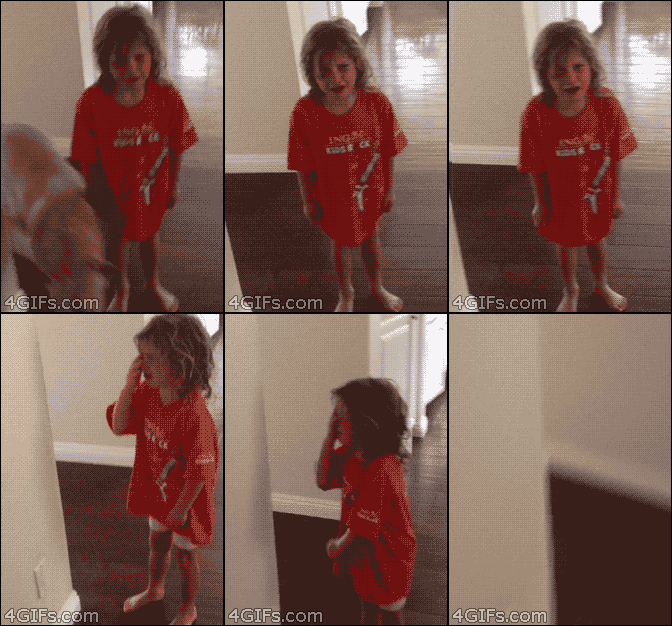
He accosted Marcie in the hall today and asked her who had "turned him in." Marcie was kind enough to hold her tongue and not tell him that there were at least four independent complaints.
All I have to say is:

Thursday, March 03, 2016
God, I love nursing students. And new nurses. And newbies, in general.
The best shifts I have come when I get to precept nursing students or new nurses. It doesn't happen very often, probably because I have a bad, bad reputation with Manglement when it comes to new RNs. I say things like "Don't let that doctor talk down to you!" and then call the doc in question out when he's been an asshole. That does not make me popular with people whose job it is to make sure the fruit plate in the doctors' lounge is fresh and full of papaya.
Still. . . .when I get to precept a new nurse, or a student, it's such a freakin' high. People who don't know a lot, or anything, about a discipline ask the best questions. I'll be talking to a newbie about the diagnosis for Mister X, and say something like "and, of course, he's very disinhibited because he had this right-sided stroke" and the newbie will be all "Wait, what?" and then I'll have to explain it in plain English. Which is exciting, because of the whole translation aspect, and also because I have to dig deep into this brain that's been doing this for a long time and come up with answers to the questions that'll certainly follow.
So, Newbies of every stripe, pay attention:
1. Really and truly, no question is a dumb question.
No, seriously. If you ask me a question that is extremely basic, I will not get mad at you. Often the most basic points of a problem are obscured by language or the cool stuff that isn't so basic. Ask away.
2. If you meet an instructor who says "Nurses eat their young" or "All nurses are codependent," look at them only through slitted eyes.
Most nursing instructors these days are, thank God, decent nurses. Still, you'll occasionally run into one who couldn't hack basic nursing, either because of a lack of brains or a lack of spine. Those are the ones who will tell you horror stories about nurses. Ignore them. Most of us--especially the younger ones--are without bullshit and without an agenda. We want you to succeed, we want to see you on the floor with us, and we're ready and willing to help you out.
3. Likewise, be aware of the Cunt Nurse.
The very first day I was on my own after orientation, back in the Jurassic period, I was present for a conversation between two Old Nurses. They were talking about a neurosurgery resident, a woman, who was both extremely bright and more than usually attractive. The gist of their discussion was that she must've slept with the chair of the department to have gotten as far as she did.
I remember sitting quietly, sorting my charts out, and thinking "Jesus, that nurse is a fucking cunt." I was right. She *is* a fucking cunt, and I still work with her, and I've not seen anything in the past fifteen years to convince me differently. (The other nurse she was talking with was a manager, and was fired shortly thereafter.)
The point here is that if somebody badmouths a colleague without reason, or fakes a kidney stone to get out of precepting you, or generally makes you think "that person is a cunt," you are probably right. And cunts never change. Avoid them.
4. Please have the basics down.
And by that, I mean the absolute basics. Know how to tell the upper back from the lower back. Know where the brain is (hint: it's on top). Be aware of how to take a pulse. (Note that I don't require anybody to be able to take a manual blood pressure; it's surprisingly tricky and needs lots of practice.) Know how many legs your average human should have, and whether or not your patient has a uterus. I don't require more than that, honestly. Unless you cop an attitude, and then I will make you sweat.
5. As for making you sweat, we won't do it in a mean way.
Unless you cop an attitude. As I did when I was a new nurse, and boy, did I ever have to answer for it. We may ask you tricky questions and wait, as you shift from foot to foot and glance at your fellow newbies for help, until we give you the answer or you come up with something that we'd never thought of before. We won't pimp you the way doctors do, don't worry.
Mostly, honestly, we ask you questions not because we want to know if you have the textbook answer, but because we want to see you work out a plausible answer on your own. Hell, I'll take a flamingly wrong answer that's well-conceived over a boring, flat textbook answer, simply because the wrong one was more interesting and gave more scope for teaching.
Don't be scared. Unless you're an asshole. Then, be scared.
Still. . . .when I get to precept a new nurse, or a student, it's such a freakin' high. People who don't know a lot, or anything, about a discipline ask the best questions. I'll be talking to a newbie about the diagnosis for Mister X, and say something like "and, of course, he's very disinhibited because he had this right-sided stroke" and the newbie will be all "Wait, what?" and then I'll have to explain it in plain English. Which is exciting, because of the whole translation aspect, and also because I have to dig deep into this brain that's been doing this for a long time and come up with answers to the questions that'll certainly follow.
So, Newbies of every stripe, pay attention:
1. Really and truly, no question is a dumb question.
No, seriously. If you ask me a question that is extremely basic, I will not get mad at you. Often the most basic points of a problem are obscured by language or the cool stuff that isn't so basic. Ask away.
2. If you meet an instructor who says "Nurses eat their young" or "All nurses are codependent," look at them only through slitted eyes.
Most nursing instructors these days are, thank God, decent nurses. Still, you'll occasionally run into one who couldn't hack basic nursing, either because of a lack of brains or a lack of spine. Those are the ones who will tell you horror stories about nurses. Ignore them. Most of us--especially the younger ones--are without bullshit and without an agenda. We want you to succeed, we want to see you on the floor with us, and we're ready and willing to help you out.
3. Likewise, be aware of the Cunt Nurse.
The very first day I was on my own after orientation, back in the Jurassic period, I was present for a conversation between two Old Nurses. They were talking about a neurosurgery resident, a woman, who was both extremely bright and more than usually attractive. The gist of their discussion was that she must've slept with the chair of the department to have gotten as far as she did.
I remember sitting quietly, sorting my charts out, and thinking "Jesus, that nurse is a fucking cunt." I was right. She *is* a fucking cunt, and I still work with her, and I've not seen anything in the past fifteen years to convince me differently. (The other nurse she was talking with was a manager, and was fired shortly thereafter.)
The point here is that if somebody badmouths a colleague without reason, or fakes a kidney stone to get out of precepting you, or generally makes you think "that person is a cunt," you are probably right. And cunts never change. Avoid them.
4. Please have the basics down.
And by that, I mean the absolute basics. Know how to tell the upper back from the lower back. Know where the brain is (hint: it's on top). Be aware of how to take a pulse. (Note that I don't require anybody to be able to take a manual blood pressure; it's surprisingly tricky and needs lots of practice.) Know how many legs your average human should have, and whether or not your patient has a uterus. I don't require more than that, honestly. Unless you cop an attitude, and then I will make you sweat.
5. As for making you sweat, we won't do it in a mean way.
Unless you cop an attitude. As I did when I was a new nurse, and boy, did I ever have to answer for it. We may ask you tricky questions and wait, as you shift from foot to foot and glance at your fellow newbies for help, until we give you the answer or you come up with something that we'd never thought of before. We won't pimp you the way doctors do, don't worry.
Mostly, honestly, we ask you questions not because we want to know if you have the textbook answer, but because we want to see you work out a plausible answer on your own. Hell, I'll take a flamingly wrong answer that's well-conceived over a boring, flat textbook answer, simply because the wrong one was more interesting and gave more scope for teaching.
Don't be scared. Unless you're an asshole. Then, be scared.
Saturday, February 20, 2016
Today I went to a funeral.
I walked in to the church and looked for people I knew. The first person I spotted was Mike, Jenna's husband, so I walked straight up to him and hugged him.
I have never seen anyone look as empty as he did.
Then Jenna's mother found me, and her brothers, and her various other relatives, and I got hugged and kissed to the point that I no longer cared about leaving makeup marks on their nice clothes.
I sat down about six rows from the back, in a pew that didn't have anybody in it. I stayed there until the music started and the family came down the aisle. Jenna's mom grabbed me and said, "Jo, you're family. Come sit with us." I started to ask "Are you sure?" but she had my hand so tight that I decided to shut the hell up and go with it.
So I ended up in what was nominally a family pew, right behind the family, with Lauren and Casey, the PAs who took care of Jenna when she was really sick.
I'm glad they were there. I didn't cry because they were there.
Everybody there but me, I think, was a believer. They read poetry and psalms and proverbs, and talked about the value of a capable and thoughtful wife. They talked about the love of a good friend, and how they were sure she would be waiting for them in Heaven when they died. They called her a pearl of great price and said her value was beyond that of rubies.
Here is the Jenna I know, the one who I was both nurse to and friends with:
She was jealous of the shirt that I have that says "My cancer is rarer than your cancer. Neener neener."
She was always more than ready to talk about something other than her illness. Mostly, that something was how ready she was to get back to work (teaching) or her kids or her husband, but it also turned to how weird life could be.
She was totally unshockable. I sent her texts with pictures of the guys across the street doing half-naked yoga on their roof, or the pile of clothes somebody left in my front yard, or the latest whacko project that one of the neighbors had conceived, and her response was always "I miss Littleton. It's such a great place!" Sometimes that was followed by "Did that dude ever come get his clothes?"
Jenna was never, that I saw, really angry about what had happened to her. I'm sure she got angry at times, or got rebellious against what she saw as God's plan for her, but she never did so with me. That's not to imply that she simply accepted things as they were: she most emphatically did not. As Lauren said, the most incredible thing to watch was how she went from being scared and anxious to being strong and confident. She didn't so much fight as she just lived, in defiance of everything.
Mike and Jenna visited me at work one day and I asked to see her head. She was really, really cute without hair. Like, more attractive than anybody has a right to be.
At her funeral, there was a slideshow: Jenna with Mike. Jenna with college friends. Jenna, as a toddler, dressed up in a bee costume, her grandmother by her side. Jenna holding a fishing pole, frowning at somebody off-camera as she stood knee-deep in a river. Jenna sitting atop some promontory somewhere, with all the sky behind her, having hiked all that way. Jenna pregnant by the ocean.
Jenna and her baby son, both of them bald as cueballs, grinning the same grin.
Here is the secret of being a nurse: your memory becomes a library of people who are no longer here. Sometimes that makes you feel like there's been too much grief. Sometimes it makes you angry at a God that you're not even sure exists, because if He or She did, then why would we need children's hospitals or funerals where toddlers are in the front row? Mostly, though, it just makes you thankful.
I didn't make a huge difference, or do anything heroic, or actually do anything special. All I did was break my personal rule and become friends with a patient. This time, that person died. This time, I was stupid and opened myself up to that horrible feeling of not having done enough, the feeling of having failed a person who is much better and kinder than I will ever be.
And next time, I will do the same damn thing all over again.
I got lucky this time. I met Jenna, and I am proud to have been her friend. She was good people.
And I will never, ever, ever forget her.
I have never seen anyone look as empty as he did.
Then Jenna's mother found me, and her brothers, and her various other relatives, and I got hugged and kissed to the point that I no longer cared about leaving makeup marks on their nice clothes.
I sat down about six rows from the back, in a pew that didn't have anybody in it. I stayed there until the music started and the family came down the aisle. Jenna's mom grabbed me and said, "Jo, you're family. Come sit with us." I started to ask "Are you sure?" but she had my hand so tight that I decided to shut the hell up and go with it.
So I ended up in what was nominally a family pew, right behind the family, with Lauren and Casey, the PAs who took care of Jenna when she was really sick.
I'm glad they were there. I didn't cry because they were there.
Everybody there but me, I think, was a believer. They read poetry and psalms and proverbs, and talked about the value of a capable and thoughtful wife. They talked about the love of a good friend, and how they were sure she would be waiting for them in Heaven when they died. They called her a pearl of great price and said her value was beyond that of rubies.
Here is the Jenna I know, the one who I was both nurse to and friends with:
She was jealous of the shirt that I have that says "My cancer is rarer than your cancer. Neener neener."
She was always more than ready to talk about something other than her illness. Mostly, that something was how ready she was to get back to work (teaching) or her kids or her husband, but it also turned to how weird life could be.
She was totally unshockable. I sent her texts with pictures of the guys across the street doing half-naked yoga on their roof, or the pile of clothes somebody left in my front yard, or the latest whacko project that one of the neighbors had conceived, and her response was always "I miss Littleton. It's such a great place!" Sometimes that was followed by "Did that dude ever come get his clothes?"
Jenna was never, that I saw, really angry about what had happened to her. I'm sure she got angry at times, or got rebellious against what she saw as God's plan for her, but she never did so with me. That's not to imply that she simply accepted things as they were: she most emphatically did not. As Lauren said, the most incredible thing to watch was how she went from being scared and anxious to being strong and confident. She didn't so much fight as she just lived, in defiance of everything.
Mike and Jenna visited me at work one day and I asked to see her head. She was really, really cute without hair. Like, more attractive than anybody has a right to be.
At her funeral, there was a slideshow: Jenna with Mike. Jenna with college friends. Jenna, as a toddler, dressed up in a bee costume, her grandmother by her side. Jenna holding a fishing pole, frowning at somebody off-camera as she stood knee-deep in a river. Jenna sitting atop some promontory somewhere, with all the sky behind her, having hiked all that way. Jenna pregnant by the ocean.
Jenna and her baby son, both of them bald as cueballs, grinning the same grin.
Here is the secret of being a nurse: your memory becomes a library of people who are no longer here. Sometimes that makes you feel like there's been too much grief. Sometimes it makes you angry at a God that you're not even sure exists, because if He or She did, then why would we need children's hospitals or funerals where toddlers are in the front row? Mostly, though, it just makes you thankful.
I didn't make a huge difference, or do anything heroic, or actually do anything special. All I did was break my personal rule and become friends with a patient. This time, that person died. This time, I was stupid and opened myself up to that horrible feeling of not having done enough, the feeling of having failed a person who is much better and kinder than I will ever be.
And next time, I will do the same damn thing all over again.
I got lucky this time. I met Jenna, and I am proud to have been her friend. She was good people.
And I will never, ever, ever forget her.
Monday, February 15, 2016
Things of which I will never tire, part three thousand and forty-six:
1. The look on an attending's face when the nursing staff in the NCCU actually knows something. We read our patients' charts before the shift begins, we review lab results, we read EKGs and check out the results on CT scans and EEGs. Yet, for some reason, the attendings will never get over that first, pure shock of a simple nurse knowing something he (usually "he") doesn't about a patient.
(Nota bene: this is not all attendings, just a couple. Dr. Vizzini and Dr. Manbags come to mind.)
2. Pure thankfulness from a resident when we solve a problem or save them from a hideous fate. Dude/ette, that's what we're here for. You got problems? Yo, we'll solve them. Check out our scans while the 'puter revolves 'em.
3. The patients who say they don't want to take metoprolol/metformin/insulin/hydralazide for their problems, because they "don't want to mess up (their) bodies with medicine." These patients fall, generally, into two camps:
a. The patient, male or female, with an A1c of 10, a resting systolic BP of 210, and a creatinine of
4; or,
b. The patient, female, with acrylic nails, bleached hair, Botox, breast implants, and liposuction,
who has had her mercury amalgam fillings removed because they leak "toxins" into her
bloodstream.
*** *** *** *** ***
Yes, I've been a long time gone. For that, I do truly apologize.
Back in December, the fine folks at Mind Over Media, the people who'd been my liason with Scrubs online magazine, informed me that my services as an essayist would no longer be necessary. (Nothing wrong on my part; Scrubs decided to go in a more fashion-related, nurse-o-nality {dear sweet baby Jesus} driven direction).
I realized quite suddenly about three weeks ago that I'd been blogging, or writing weekly essays for some company or other, for more than twenty years. It started in the early 1990's with a website called ParentsPlace and went from there. I also suddenly realized, about three weeks ago, that I hadn't written shit for HN, and it actually felt pretty good. So I continued on, not writing anything, until I had had enough "I've got to blog this" moments at work and in my personal life to make it worthwhile to put fingers to keyboard again.
It's a little strange, having dissected both my personal and professional lives for--hang on to your asses--twelve years!! to suddenly stop, but I think it was good. I quit looking at life through the lens of bloggable versus boring, and had a break from trying to stage things in writing in my head. Maybe the quality of my stories will improve? Perhaps that's too much to hope, but it's been an instructive, and very pleasant, break.
Thanks to all of you who wrote, wondering if I had been abducted by aliens, the Zeta cartel, an underground supplier of international supermodels, or PETA. I am fine, and I appreciate your concern.
That said, I have to make lunch for tomorrow. We have a brand-new attending, just hired on, whom we have to break in. My job will be getting him used to reports that contain Queen lyrics.
(Nota bene: this is not all attendings, just a couple. Dr. Vizzini and Dr. Manbags come to mind.)
2. Pure thankfulness from a resident when we solve a problem or save them from a hideous fate. Dude/ette, that's what we're here for. You got problems? Yo, we'll solve them. Check out our scans while the 'puter revolves 'em.
3. The patients who say they don't want to take metoprolol/metformin/insulin/hydralazide for their problems, because they "don't want to mess up (their) bodies with medicine." These patients fall, generally, into two camps:
a. The patient, male or female, with an A1c of 10, a resting systolic BP of 210, and a creatinine of
4; or,
b. The patient, female, with acrylic nails, bleached hair, Botox, breast implants, and liposuction,
who has had her mercury amalgam fillings removed because they leak "toxins" into her
bloodstream.
*** *** *** *** ***
Yes, I've been a long time gone. For that, I do truly apologize.
Back in December, the fine folks at Mind Over Media, the people who'd been my liason with Scrubs online magazine, informed me that my services as an essayist would no longer be necessary. (Nothing wrong on my part; Scrubs decided to go in a more fashion-related, nurse-o-nality {dear sweet baby Jesus} driven direction).
I realized quite suddenly about three weeks ago that I'd been blogging, or writing weekly essays for some company or other, for more than twenty years. It started in the early 1990's with a website called ParentsPlace and went from there. I also suddenly realized, about three weeks ago, that I hadn't written shit for HN, and it actually felt pretty good. So I continued on, not writing anything, until I had had enough "I've got to blog this" moments at work and in my personal life to make it worthwhile to put fingers to keyboard again.
It's a little strange, having dissected both my personal and professional lives for--hang on to your asses--twelve years!! to suddenly stop, but I think it was good. I quit looking at life through the lens of bloggable versus boring, and had a break from trying to stage things in writing in my head. Maybe the quality of my stories will improve? Perhaps that's too much to hope, but it's been an instructive, and very pleasant, break.
Thanks to all of you who wrote, wondering if I had been abducted by aliens, the Zeta cartel, an underground supplier of international supermodels, or PETA. I am fine, and I appreciate your concern.
That said, I have to make lunch for tomorrow. We have a brand-new attending, just hired on, whom we have to break in. My job will be getting him used to reports that contain Queen lyrics.
Monday, November 23, 2015
"Take a right by the porta-potty, then a left after the second backhoe."
If you were to come to Casa Del Doghair, those would be the directions you'd get.
Every five years or so, Littleton's infrastructure guys decide it's time to replace the gas lines/sanitary sewers (that's how they refer to them: "sanitary sewers." I would hope there's no other kind)/water lines/electrical distribution system/various bits of asphalt in my neighborhood. This month, it's the sewer lines.
Do you have any idea how big sewer lines can be? I did not until this week. Apparently, replacing several thousand linear feet of sewer lines requires backhoes, something The Boyfiend calls a backtracker (on reflection, I think he made that up), a crane, and a whole shitload, pun intended, of disturbingly large plastic-and-metal tubes. These things are large enough to get lost in. And right now, five of them are piled up on what used to be my side yard.
So be careful if you come visit. Don't climb on the equipment. And for God's sake, don't cut that left after the second backhoe too close, or you'll end up ten feet underground in a big hole, with a bunch of men in orange vests staring down at you.
In non-sanitary-sewer-related news, nursing, both as a job and a concept, is eating my lunch. Mostly as a job. The concept of nursing is fine and dandy and I'm still all up in its metaphorical grill, but the practice? is leaving some tread marks across my back.
Part of it is the new residents we've got at the moment. We trade out residents more frequently than just once a year, so every four months or so, it's like July all over again. Not all of 'em leave, of course, but we get enough new post-grad-twos and threes to make things exciting. Here's an example:
SCENE: Interior, day, conference room. Six doctors are milling about, drinking coffee and PSLs and munching on PowerBars.
DOCTOR ONE: Okay, you guys. We have a full house today, so we've got to move somebody out of the unit. Who've we got that can go to the floor?
DOCTOR TWO: Um. . . .let's see. We have three TIAs that are stable and almost done with their workups. We have that patient with the left MCA stroke who's waiting on rehab placement, and the lady with the cerebellar stroke who needs a cardiology consult. Oh, and then we have that one guy with rhabdo, in status, with an insulin drip, who we're working up for DIC. He's four hundred pounds and in four-point restraints, too.
DOCTOR THREE: Sounds to me like we ought to move out the rhabdo.
DOCTOR ONE: Great idea. You write the orders and I'll let bed control know. Oh, and listen: be sure you write an order for strict ins and outs and put in the notes to nursing that they have to d/c that Foley immediately, okay?
I'm spending Thanksgiving with the weirder half of The Boyfiend's family, in a prepper compound, with feral-hog hunting as part of the weekend's entertainment. At this point, I am looking forward to it.
And maybe, before I go back to work, I'll end up at the bottom of a deep hole under a backhoe with a bunch of men in orange vests staring down at me.
Every five years or so, Littleton's infrastructure guys decide it's time to replace the gas lines/sanitary sewers (that's how they refer to them: "sanitary sewers." I would hope there's no other kind)/water lines/electrical distribution system/various bits of asphalt in my neighborhood. This month, it's the sewer lines.
Do you have any idea how big sewer lines can be? I did not until this week. Apparently, replacing several thousand linear feet of sewer lines requires backhoes, something The Boyfiend calls a backtracker (on reflection, I think he made that up), a crane, and a whole shitload, pun intended, of disturbingly large plastic-and-metal tubes. These things are large enough to get lost in. And right now, five of them are piled up on what used to be my side yard.
So be careful if you come visit. Don't climb on the equipment. And for God's sake, don't cut that left after the second backhoe too close, or you'll end up ten feet underground in a big hole, with a bunch of men in orange vests staring down at you.
In non-sanitary-sewer-related news, nursing, both as a job and a concept, is eating my lunch. Mostly as a job. The concept of nursing is fine and dandy and I'm still all up in its metaphorical grill, but the practice? is leaving some tread marks across my back.
Part of it is the new residents we've got at the moment. We trade out residents more frequently than just once a year, so every four months or so, it's like July all over again. Not all of 'em leave, of course, but we get enough new post-grad-twos and threes to make things exciting. Here's an example:
SCENE: Interior, day, conference room. Six doctors are milling about, drinking coffee and PSLs and munching on PowerBars.
DOCTOR ONE: Okay, you guys. We have a full house today, so we've got to move somebody out of the unit. Who've we got that can go to the floor?
DOCTOR TWO: Um. . . .let's see. We have three TIAs that are stable and almost done with their workups. We have that patient with the left MCA stroke who's waiting on rehab placement, and the lady with the cerebellar stroke who needs a cardiology consult. Oh, and then we have that one guy with rhabdo, in status, with an insulin drip, who we're working up for DIC. He's four hundred pounds and in four-point restraints, too.
DOCTOR THREE: Sounds to me like we ought to move out the rhabdo.
DOCTOR ONE: Great idea. You write the orders and I'll let bed control know. Oh, and listen: be sure you write an order for strict ins and outs and put in the notes to nursing that they have to d/c that Foley immediately, okay?
I'm spending Thanksgiving with the weirder half of The Boyfiend's family, in a prepper compound, with feral-hog hunting as part of the weekend's entertainment. At this point, I am looking forward to it.
And maybe, before I go back to work, I'll end up at the bottom of a deep hole under a backhoe with a bunch of men in orange vests staring down at me.
Thursday, October 15, 2015
Whaaa. . . .what? Wait, what?
The family member insists that I called her a bitch during report.
Okay. (Nods head.) A reasonable assumption.
Except I didn't. I see no point in prejudicing another nurse against a patient's family member, or using profanity during report. As opposed to the rest of the workday, when I'll happily use profanity whenever.
But this particular family member? The one who threatened to sue because the room wasn't big enough? The one who tried to get her aunt arrested for simply visiting the patient? I wouldn't call her a bitch, even in an undertone, because that would get me in trouble. I still have some self-preservation instincts left, even after more than a dozen years. Besides all that, she was worried, but not necessarily a bitch. I took the reports of her calling out security and all the other crazy behavior with a grain of salt; a lot can happen when you're stressed.
My boss, who is a thoughtful, reasonable woman, heard the news with a mild snurk and let it go on past. My explanation to her was "I got no defense; I can't help you on this one," and she took it as read and filed the complaint in the round-file.
But still. Why on earth would you say that about somebody who's wiping your father's butt, not to put too fine a point on it? Why would you try to turn all the other nurses against one nurse with an alleged (admitted) foul mouth? Are you truly that mentally ill, that you need to have an adversary in every single interaction you have with the outside world?
If people ask me what my least favorite aspect of my job is, I tell them this: it's folks who have a habit of conflict making up conflict where it doesn't exist. It bothers me, not on a personal level--because my conscience is clear--but on an existential level. What makes some people nuts? I don't get it.
I seriously don't get it.
But I'm not going to call you a bitch just 'cause I don't understand you.
Okay. (Nods head.) A reasonable assumption.
Except I didn't. I see no point in prejudicing another nurse against a patient's family member, or using profanity during report. As opposed to the rest of the workday, when I'll happily use profanity whenever.
But this particular family member? The one who threatened to sue because the room wasn't big enough? The one who tried to get her aunt arrested for simply visiting the patient? I wouldn't call her a bitch, even in an undertone, because that would get me in trouble. I still have some self-preservation instincts left, even after more than a dozen years. Besides all that, she was worried, but not necessarily a bitch. I took the reports of her calling out security and all the other crazy behavior with a grain of salt; a lot can happen when you're stressed.
My boss, who is a thoughtful, reasonable woman, heard the news with a mild snurk and let it go on past. My explanation to her was "I got no defense; I can't help you on this one," and she took it as read and filed the complaint in the round-file.
But still. Why on earth would you say that about somebody who's wiping your father's butt, not to put too fine a point on it? Why would you try to turn all the other nurses against one nurse with an alleged (admitted) foul mouth? Are you truly that mentally ill, that you need to have an adversary in every single interaction you have with the outside world?
If people ask me what my least favorite aspect of my job is, I tell them this: it's folks who have a habit of conflict making up conflict where it doesn't exist. It bothers me, not on a personal level--because my conscience is clear--but on an existential level. What makes some people nuts? I don't get it.
I seriously don't get it.
But I'm not going to call you a bitch just 'cause I don't understand you.
Friday, October 09, 2015
Today, Raji came to me. Raji's about as Indian as Indian can be.
Perfect vase-shaped figure, long black braid, gorgeous gold earrings, and a bindi. Raji is recognizably Indian. And she came to me with the revelation that my confused patient had called her "Senorita."
I explained that he'd probably seen the long black hair and the honey-colored skin and thought that she was Hispanic. She laughed and laughed and laughed.
Later, when I'd had a minor disagreement with an attending (more on that in the days to come), she exclaimed, when I mentioned his recognizably-Indian name, "Oh! I thought he was Hispanic!"
"Hello, Senorita!" I responded. "How are we supposed to have world peace when y'all can't recognize each other from across the room?"
This is what passes for humor on my unit on a hard day.
I explained that he'd probably seen the long black hair and the honey-colored skin and thought that she was Hispanic. She laughed and laughed and laughed.
Later, when I'd had a minor disagreement with an attending (more on that in the days to come), she exclaimed, when I mentioned his recognizably-Indian name, "Oh! I thought he was Hispanic!"
"Hello, Senorita!" I responded. "How are we supposed to have world peace when y'all can't recognize each other from across the room?"
This is what passes for humor on my unit on a hard day.
Sunday, October 04, 2015
"Why don't we ask the patient?"
Marcie and I had One Of Those Days a couple of weeks ago. Dr. Vizzini had to go do something neurological halfway through the day, so The Golden Boy took over for him in the afternoon. He gathered his residents like ducklings and re-rounded on all of the patients in the unit.
Marcie had a guy getting ready to go home. He'd had a very minor stroke in a very minor place, and was essentially without any aftereffects. He also had Stage IV cancer of the something-or-other--I don't remember what; I was busy myself--and was on so many anticoagulants it was ridiculous. (Cancer can make a person more prone to blood clots.) The fact that he'd stroked while on an injectable anticoagulant and a couple of oral ones was weird, but not unheard of.
So Mister Man was getting ready to blow that popsicle stand when The Golden Boy decided that he needed umpteen more blood tests, a couple of fairly-invasive scans, another MRI, and some other tests run. To see, you understand, what exactly could be causing him to clot. The answer to which conundrum was "metastatic cancer, DUH," but TGB wanted an exact answer. Like, down to the molecular derangement level.
And Marcie, being the sensible person she is, argued. She pointed out that we had at least a general idea of what the problem was (metastatic cancer, DUH), the patient had a limited amount of time to be futzing around with, and nothing we did at this point was going to make a damn bit of difference. There was, after all, no change we could make to his already-maxed-out medications to lower his risk of stroking again. More tests would mean at least two more days in the hospital, more discomfort, possible complications, and added cost.
Golden Boy argued back that it was incumbent upon him as a doctor to get to the bottom of the problem, and that doing less than that wasn't ethical. He had a couple of other arguments, but by that time, both my hair and my pants were on fire and I wasn't really listening.
Marcie and TGB argued politely back and forth for a few minutes, and then Marcie said something that you never, ever, ever hear somebody in a hospital say:
"Why don't we ask this guy what he wants to do?"
The Golden Boy was taken aback, but he did it. Our patient decided to head home and follow up with his oncologist as an outpatient. And just like that, problem solved.
It's interesting that a doctor would be shocked by another member of the care team wanting a patient's input into what happens to the patient. I mean, we do it all the time for big decisions like end-of-life care, but not as often when we're doing normal everyday stuff. Why not, I wonder? I mean, it's not like being in the hospital automatically robs you of the ability to make good decisions about your own health. It's more like being in the hospital sends you back in time to a more paternalistic day, when Doctor Knew Best (except for when you have a medical directive, and sometimes even then).
It's so simple, really. Ask the patient what they want to do. Just ask.
Marcie had a guy getting ready to go home. He'd had a very minor stroke in a very minor place, and was essentially without any aftereffects. He also had Stage IV cancer of the something-or-other--I don't remember what; I was busy myself--and was on so many anticoagulants it was ridiculous. (Cancer can make a person more prone to blood clots.) The fact that he'd stroked while on an injectable anticoagulant and a couple of oral ones was weird, but not unheard of.
So Mister Man was getting ready to blow that popsicle stand when The Golden Boy decided that he needed umpteen more blood tests, a couple of fairly-invasive scans, another MRI, and some other tests run. To see, you understand, what exactly could be causing him to clot. The answer to which conundrum was "metastatic cancer, DUH," but TGB wanted an exact answer. Like, down to the molecular derangement level.
And Marcie, being the sensible person she is, argued. She pointed out that we had at least a general idea of what the problem was (metastatic cancer, DUH), the patient had a limited amount of time to be futzing around with, and nothing we did at this point was going to make a damn bit of difference. There was, after all, no change we could make to his already-maxed-out medications to lower his risk of stroking again. More tests would mean at least two more days in the hospital, more discomfort, possible complications, and added cost.
Golden Boy argued back that it was incumbent upon him as a doctor to get to the bottom of the problem, and that doing less than that wasn't ethical. He had a couple of other arguments, but by that time, both my hair and my pants were on fire and I wasn't really listening.
Marcie and TGB argued politely back and forth for a few minutes, and then Marcie said something that you never, ever, ever hear somebody in a hospital say:
"Why don't we ask this guy what he wants to do?"
The Golden Boy was taken aback, but he did it. Our patient decided to head home and follow up with his oncologist as an outpatient. And just like that, problem solved.
It's interesting that a doctor would be shocked by another member of the care team wanting a patient's input into what happens to the patient. I mean, we do it all the time for big decisions like end-of-life care, but not as often when we're doing normal everyday stuff. Why not, I wonder? I mean, it's not like being in the hospital automatically robs you of the ability to make good decisions about your own health. It's more like being in the hospital sends you back in time to a more paternalistic day, when Doctor Knew Best (except for when you have a medical directive, and sometimes even then).
It's so simple, really. Ask the patient what they want to do. Just ask.
Saturday, October 03, 2015
People who love my hair and people who do not.
I just ran the clippers through my hair. It's my every-two-week routine: pass a pair of clippers with a #3 guard over my head, then fade out the sides and back with a #2. Then, carefully, measure out an ounce each of color and developer and apply it to the stubble on my head and let it rest for twenty-five minutes. When I remember, I dye my eyebrows as well. My eyebrows have gone white, as has the hair at my temples and the nape of my neck, and it's nice to have at least an outline to pencil in in the mornings.
Here are the people who love my hair:
1. Black women of any age. "Rockin' that 'fro, Boo" is what I hear from Friend Lisa at work, and I hear its equivalent from other Black women of varying ages, all day long.
2. Black men in their 60's. On Sundays when everybody comes to visit their fellow parishioners in the hospital, Black men Of A Certain Age are complimentary of my buzzcut.
3. World War 2 veterans of any ethnicity. It's surprising how many centenarians and men in their 90's comment favorably on a woman with really, really short hair.
4. Punks, people with excessive numbers of tattoos, and people with piercings in places you wouldn't necessarily want piercings. The fact that I have no hair breaks down barriers.
5. White women who've had cancer and who miss the ease of a buzz, but who hate the psychological implications of no hair. I can totally understand that. After my surgery, I grew out my hair to prove to myself I could, then cut it off on my 43rd birthday because I hated having to keep up with it.
And here is a comprehensive list of those people who hate my hair:
1. My dad. Bless his heart, I don't think he'll ever imagine me with anything but the curly, wild, shoulder-length red hair that I had in my early 20's. I feel bad for him. Not only is curly, wild, red hair a distraction and a pain in the ass to take care of, it's just. Not. Me.
Sometimes I wish I could go back to the days when Beloved Sister took a picture of me, all hair blown by the wind, on the beach near San Francisco. What that picture doesn't show, though, is the stress and horror of being in California when I didn't want to be, the stink that came from my hair not reacting well to California water, and the exhaustion of trying to keep together a marriage that was coming apart.
Mom is undecided. I think she thinks something chin-length with waves might be more flattering, but she understands the discipline of long hair and why I can't deal with it.
Here are the people who love my hair:
1. Black women of any age. "Rockin' that 'fro, Boo" is what I hear from Friend Lisa at work, and I hear its equivalent from other Black women of varying ages, all day long.
2. Black men in their 60's. On Sundays when everybody comes to visit their fellow parishioners in the hospital, Black men Of A Certain Age are complimentary of my buzzcut.
3. World War 2 veterans of any ethnicity. It's surprising how many centenarians and men in their 90's comment favorably on a woman with really, really short hair.
4. Punks, people with excessive numbers of tattoos, and people with piercings in places you wouldn't necessarily want piercings. The fact that I have no hair breaks down barriers.
5. White women who've had cancer and who miss the ease of a buzz, but who hate the psychological implications of no hair. I can totally understand that. After my surgery, I grew out my hair to prove to myself I could, then cut it off on my 43rd birthday because I hated having to keep up with it.
And here is a comprehensive list of those people who hate my hair:
1. My dad. Bless his heart, I don't think he'll ever imagine me with anything but the curly, wild, shoulder-length red hair that I had in my early 20's. I feel bad for him. Not only is curly, wild, red hair a distraction and a pain in the ass to take care of, it's just. Not. Me.
Sometimes I wish I could go back to the days when Beloved Sister took a picture of me, all hair blown by the wind, on the beach near San Francisco. What that picture doesn't show, though, is the stress and horror of being in California when I didn't want to be, the stink that came from my hair not reacting well to California water, and the exhaustion of trying to keep together a marriage that was coming apart.
Mom is undecided. I think she thinks something chin-length with waves might be more flattering, but she understands the discipline of long hair and why I can't deal with it.
Saturday, September 19, 2015
Here is why I love my town.
If you were to look at a map of Texas, you probably wouldn't notice Littleton at all. It's not one of those places where a river runs through downtown, free to everyone, or where huge concerts take place or where there's even a top-ranked university. It's just a small town, kind of stuck on the outskirts of a big city, but emphatically not a suburb. It's its own place.
That's why I love Littleton. The rents are cheap and there's a big airport nearby, yes, and the air is clean and coyotes and foxes and various other small animals roam through downtown (somebody found a litter of bobcat kittens behind a bar a few weeks ago and turned 'em into animal control, who is rehabbing them and re-wilding them), and it's peaceful and bucolic. And it's determinedly independent.
There are trains that run through the middle of town, just two blocks from the courthouse, every night. And every night, pretty much, you can hear the train horns blowing in some new and interesting signature way that the guys who drive them have developed. Yes, it's policy that they blow a short-short-long prior to reaching a level crossing, but the engineers have ditched the computer-programmed horns for Littleton and do their own thing. At Christmas, they blow "Jingle Bells" and "Rudolph The Red-Nosed Reindeer" rather than the usual signals.
The H.E.B. here (that's a local grocery chain) plays KISS and Ingrid Michaelson and the Bee-Gees over the speakers in the store. Rather than the usual boring "come get our chicken it's fresh between eleven and four and only a dollar ninety-nine" announcements, the staff say things over the PA like, "Is your life missing something? Do you feel empty inside? Try some CHICKEN! Fried or baked, it can bring new meaning to your existence!"
The Boyfiend's lawnmower was stolen last week and returned within three hours, thanks to the efforts of the local PD. Though they have pursuit cars and a bomb squad and a mobile emergency management truck, the officer still responded with "That sounds like Steve. Dammit. Steve needs to stop stealing lawnmowers" when he took the report. Despite technology, our PD is still small-town enough to be exasperated with the one crazy guy who makes a habit of liberating lawn equipment.
The city fathers decided to lock up the free public electrical outlets around the courthouse, but only after people started pitching tents there and setting up full-sized refrigerators that ran off the city's electricity.
We get the traffic from South By Southwest, but none of the other headaches. Bars that have live bands put up signs that say "OH MY GOD BECKY LOOK AT HER BOOKING" for that week. Gas is cheaper here, and the gas station is likely to have Mexican, Indian, or Korean home-cooked food for sale. The place I buy my beer smells of incense and kimchee.
There are four terrifying barbecue places where the meat melts off the bone and you're not advised to ask about preparation, and three terrifying Mexican places that have excellent strange salsas you've never tried before. Oh, and that little Japanese restaurant that will serve you amazing sushi if you shrug and say, "Whatever the chef wants; I'm not particular."
Soul food is cheap here. Grits are an option with everything. You can be literally thrown out of a bar, onto the street, on your ass, if you misbehave. Yet the patrons of the local gay bar will leave you alone if all you want is a beer and a book. There's a running club that meets at a local bar, three bike clubs (road, mountain, and casual), and a bird-watching group. There are two breweries and a dude who bottles home-made ginger ale and flavored seltzers. There's a soap company, two of those places that will sell you boxes of vegetables every month, and some guy who runs a barber shop out of his pickup truck and specializes in beards. Drag queens are an everyday sight. Nobody turns a hair at people of different/the same ethnicities/sexes holding hands in public. The library is one of the finest I have ever seen, and is enthusiastically supported by the locals. The city council is made up of a lawyer, a stay-at-home mom, a guy who runs the vegan restaurant, a history professor from one of Bigton's universities, some woman with oil and gas ties who is retiring this year thank God, and a couple of random business owners who want to legalize pot and skateboarding.
I was shopping today and had to do the excuse-me-I'm-in-your-way dance with a seventy-ish man in the soup aisle. It turned into a full-on dance-off and ended in a tango.
I love my town.
That's why I love Littleton. The rents are cheap and there's a big airport nearby, yes, and the air is clean and coyotes and foxes and various other small animals roam through downtown (somebody found a litter of bobcat kittens behind a bar a few weeks ago and turned 'em into animal control, who is rehabbing them and re-wilding them), and it's peaceful and bucolic. And it's determinedly independent.
There are trains that run through the middle of town, just two blocks from the courthouse, every night. And every night, pretty much, you can hear the train horns blowing in some new and interesting signature way that the guys who drive them have developed. Yes, it's policy that they blow a short-short-long prior to reaching a level crossing, but the engineers have ditched the computer-programmed horns for Littleton and do their own thing. At Christmas, they blow "Jingle Bells" and "Rudolph The Red-Nosed Reindeer" rather than the usual signals.
The H.E.B. here (that's a local grocery chain) plays KISS and Ingrid Michaelson and the Bee-Gees over the speakers in the store. Rather than the usual boring "come get our chicken it's fresh between eleven and four and only a dollar ninety-nine" announcements, the staff say things over the PA like, "Is your life missing something? Do you feel empty inside? Try some CHICKEN! Fried or baked, it can bring new meaning to your existence!"
The Boyfiend's lawnmower was stolen last week and returned within three hours, thanks to the efforts of the local PD. Though they have pursuit cars and a bomb squad and a mobile emergency management truck, the officer still responded with "That sounds like Steve. Dammit. Steve needs to stop stealing lawnmowers" when he took the report. Despite technology, our PD is still small-town enough to be exasperated with the one crazy guy who makes a habit of liberating lawn equipment.
The city fathers decided to lock up the free public electrical outlets around the courthouse, but only after people started pitching tents there and setting up full-sized refrigerators that ran off the city's electricity.
We get the traffic from South By Southwest, but none of the other headaches. Bars that have live bands put up signs that say "OH MY GOD BECKY LOOK AT HER BOOKING" for that week. Gas is cheaper here, and the gas station is likely to have Mexican, Indian, or Korean home-cooked food for sale. The place I buy my beer smells of incense and kimchee.
There are four terrifying barbecue places where the meat melts off the bone and you're not advised to ask about preparation, and three terrifying Mexican places that have excellent strange salsas you've never tried before. Oh, and that little Japanese restaurant that will serve you amazing sushi if you shrug and say, "Whatever the chef wants; I'm not particular."
Soul food is cheap here. Grits are an option with everything. You can be literally thrown out of a bar, onto the street, on your ass, if you misbehave. Yet the patrons of the local gay bar will leave you alone if all you want is a beer and a book. There's a running club that meets at a local bar, three bike clubs (road, mountain, and casual), and a bird-watching group. There are two breweries and a dude who bottles home-made ginger ale and flavored seltzers. There's a soap company, two of those places that will sell you boxes of vegetables every month, and some guy who runs a barber shop out of his pickup truck and specializes in beards. Drag queens are an everyday sight. Nobody turns a hair at people of different/the same ethnicities/sexes holding hands in public. The library is one of the finest I have ever seen, and is enthusiastically supported by the locals. The city council is made up of a lawyer, a stay-at-home mom, a guy who runs the vegan restaurant, a history professor from one of Bigton's universities, some woman with oil and gas ties who is retiring this year thank God, and a couple of random business owners who want to legalize pot and skateboarding.
I was shopping today and had to do the excuse-me-I'm-in-your-way dance with a seventy-ish man in the soup aisle. It turned into a full-on dance-off and ended in a tango.
I love my town.
Wednesday, September 09, 2015
Happy Lumpiversary and 'Bye, Felicia.
Five years ago I was sitting in my dentist's chair when his hygienist found a lump on my hard palate. The lump, known as Cap'n Lumpy after that, turned out to be a rare-ish form of minor salivary gland cancer called polymorphous low-grade adenocarcinoma.
It started a year-long freakout on my part, most of which is documented on this here blog, that culminated in my wearing a cool plastic-and-metal prosthetic to replace the chunk of my mouth that a surgeon removed.
I'm not sure how I feel about this, so I'm gonna just mark this lumpiversary and leave it be. I have the latest set of scans (CT and MRI) coming up week after next. I'm not sure how I feel about that, either. Maybe it'll be easier once I transition to once-a-year rather than once-every-six-months scanning; maybe it'll be a whole new kind of hell. We'll see.
In other news, Keith is gone. I don't know the details, having been on vacation this last two weeks, but he's been relieved of his duties at Sunnydale and has gone back to the pit that spawned him. It probably had something to do with a patient decompensating to the point that she had to be intubated on his watch, with nobody but him being aware of it. I don't know. All I know for sure is that I can work now without having to worry about somebody else's patients as well as my own.
So. One okay thing, one good thing. Not a bad way to start off the new year.
It started a year-long freakout on my part, most of which is documented on this here blog, that culminated in my wearing a cool plastic-and-metal prosthetic to replace the chunk of my mouth that a surgeon removed.
I'm not sure how I feel about this, so I'm gonna just mark this lumpiversary and leave it be. I have the latest set of scans (CT and MRI) coming up week after next. I'm not sure how I feel about that, either. Maybe it'll be easier once I transition to once-a-year rather than once-every-six-months scanning; maybe it'll be a whole new kind of hell. We'll see.
In other news, Keith is gone. I don't know the details, having been on vacation this last two weeks, but he's been relieved of his duties at Sunnydale and has gone back to the pit that spawned him. It probably had something to do with a patient decompensating to the point that she had to be intubated on his watch, with nobody but him being aware of it. I don't know. All I know for sure is that I can work now without having to worry about somebody else's patients as well as my own.
So. One okay thing, one good thing. Not a bad way to start off the new year.
Sunday, September 06, 2015
The best new nursing blog out there is "Florence Is Dead."
If you want smart, funny, badass commentary on the nature of nursing today, go read Florence Is Dead. It's a brand-new blog, but already it's creating waves. The Diet Coke Incident has some of the most bloviating ridiculousness in the comments section that I've ever seen.
In case you couldn't guess, I agree with pretty much everything Dead Florence writes. The one place we differ is on the scrubs issue: she'd like to see professional dress for nurses, while I stand firmly on the side of scrubs. The primary reason for that, you understand, is that I cannot dress myself. Other than that one disagreement, though, I'm firmly in DF's camp.
Go check it out. I got very excited when I stumbled across it (can't remember for the life of me how that was, sadly). Give her some love in the comments section.
In case you couldn't guess, I agree with pretty much everything Dead Florence writes. The one place we differ is on the scrubs issue: she'd like to see professional dress for nurses, while I stand firmly on the side of scrubs. The primary reason for that, you understand, is that I cannot dress myself. Other than that one disagreement, though, I'm firmly in DF's camp.
Go check it out. I got very excited when I stumbled across it (can't remember for the life of me how that was, sadly). Give her some love in the comments section.
Friday, September 04, 2015
Let's talk a little about patient satisfaction, shall we?
About a year ago, after Eric Duncan died at Texas Health Presbyterian Hospital in Dallas and two nurses who cared for him were hospitalized with the same disease that killed him (Ebola), Texas Health Resources got an independent committee to review what went wrong. It was like a root cause analysis, but more so: these were outside doctors and one nurse, they weren't paid, and they were given access to everything that was charted and all the folks involved in the Presby debacle.
They came to a number of conclusions: first, that education was lacking--the staff wasn't aware of what exactly to do in case of a person with Ebola coming in; second, that communication was poor--the nurse who took Mr. Duncan's health history didn't communicate verbally to the doc that he'd come from an Ebola-affected area; and third, that the fear of poor patient satisfaction scores led the doctors and nurses to rush Mr. Duncan through the ED that first time, in order to keep other patients from waiting and getting mad.
The fear of poor patient satisfaction scores caused the staff and doctors to rush the diagnosis of a man who had been in an Ebola-affected country.
Read that again. The fear of poor patient satisfaction scores caused the staff and doctors to rush the diagnosis of a man who had been in an Ebola-affected country.
I don't know what it's like in Dallas, but here in Bigton, every medium-sized hospital and most of the smaller ones have billboards touting how fast a person can be seen in their various EDs. Some of them even have big neon numbers that show the current wait times outside the hospital itself. A few even have those big neon numbers on billboards on the highways.
The entire focus of emergency-room care has become, at least in this area, about how fast you can be seen for belly pain. Or a broken arm. Or allergies. Yes, they advertise ED services for seasonal allergies. And it's all about the time it'll take for you to be seen. Come in with a head injury following a fall or a sore back that's been going on for a month? Doesn't matter--our goal is to have you back in a room in ten minutes or less and have you out the door in half an hour.
At the beginning of flu season here in Texas, that emphasis on speed, which is translated to patient satisfaction by administrators, contributed to already-stressed doctors and nurses missing a diagnosis that turned out to be fatal.
(There's a lot to be said on the communication front as well--why was the flag in the chart that the nurse filled out not enough to alert the doc? Was he, perhaps, rushed? Why the emphasis on verbally informing him of something, when the nurse might not actually see the doc face-to-face all shift because they're both busy? That'll have to wait, though.)
Let's take this down a notch. At Sunnydale General and Holy Kamole, there's a big push on to satisfy patients in every way possible. Press-Ganey cards are sent to each and every in- or out-patient within a week of their leaving the hospital or clinic, and the results are taken very seriously.
I work in a critical care unit. It's likely that the patients that I see will go on to spend a few weeks either on a floor or in rehab or both, and may or may not remember their time with me. Brain injuries tend to wipe out short-term memory. Even if they do remember the NCCU, they probably won't remember me by name. All this leads to a very minor chance that they'll be able to fill out a card that mentions me specifically.
Yet if I'm not mentioned by name by at least one patient in a year, preferably by two or three, I won't get a point on my employee review. It doesn't matter how many students or new nurses I precept, how many errors I catch, or how often my patients have good outcomes. What matters is that somebody who's stressed or ill, possibly without family support, remembers my name (perhaps weeks or months after seeing me for a day or two) and takes the time to mail back a postcard with my name on it. Missing that point can make the difference between a raise and no raise, or between a satisfactory or unsatisfactory review. It's weighted that heavily.
We no longer track how often certain nurses' patients get bedsores or UTIs or end up going back to the CCU. What we track now is how often they're praised by patients or family members.
As a result, I find myself doing all kinds of crazy shit to get people to remember me. We're not allowed to hand out the Press-Ganey cards or special-mention cards ourselves, so it's up to us to do everything possible to make ourselves stand out. Most of the time, for me, it's staying at the bedside a little longer to explain what's going on with the care plan, or the physiology of the disease we're dealing with, or why the patient is on a ventilator or has this or that tube.
Sometimes I have to sweeten family members or patients who are determined to be upset. I act as counsellor, waitress, and gofer. A lot of times, those patients or families take me away from jobs I ought to be doing just so I don't end up with a complaint--I didn't get them a cup of coffee, or something. If I have a patient I'm worried about because her neuro status is changing, I have to weigh the consequences of letting her go for another ten minutes versus the consequences of being seen as not "patient satisfaction oriented" enough.
The worst example of this happened after a patient, who was fully in command of all his faculties, took a swing at me. Only a complicated move reminiscent of the "Matrix" movies kept me from a broken skull. Afterwards, the assistant manager told me I had to go back and make nice with the guy. I told him no, that I would not, and further, that if he or any other patient ever tried to hit me again, I would be calling the cops and pressing assault charges, and maybe suing the hospital for making my work environment unsafe. I refused to reenter the room.
I got a note on my review that year that said "Jo is an excellent clinician but needs more work on her relationships with patients."
For all you folks who want to point out that service is part of nursing, and that serving is a holy and higher cause, you go right ahead. I serve every day that I work, from before the time that I punch in to whenever the job is done (whenever that is). Service to my fellow humans, though, does not mean martyrdom or risking personal injury. It certainly doesn't mean putting a patient's satisfaction scores ahead of their health or safety.
If you, Administration, want me to be a good nurse, then let me be a good nurse. Let me educate and comfort and calm. Let me commiserate and be compassionate and do all the things that I was trained to do, including catching med errors and fixing problems. Don't push the patient satisfaction side of the equation so hard that you forget what you hired me to be: the first, last, and best guardian of my patient's health and safety. Don't confuse happy people with good outcomes.
And for God's sake, and the sake of your patients, don't push my profession into waitress/hostess mode so hard that we all forget what nurses are here for.
They came to a number of conclusions: first, that education was lacking--the staff wasn't aware of what exactly to do in case of a person with Ebola coming in; second, that communication was poor--the nurse who took Mr. Duncan's health history didn't communicate verbally to the doc that he'd come from an Ebola-affected area; and third, that the fear of poor patient satisfaction scores led the doctors and nurses to rush Mr. Duncan through the ED that first time, in order to keep other patients from waiting and getting mad.
The fear of poor patient satisfaction scores caused the staff and doctors to rush the diagnosis of a man who had been in an Ebola-affected country.
Read that again. The fear of poor patient satisfaction scores caused the staff and doctors to rush the diagnosis of a man who had been in an Ebola-affected country.
I don't know what it's like in Dallas, but here in Bigton, every medium-sized hospital and most of the smaller ones have billboards touting how fast a person can be seen in their various EDs. Some of them even have big neon numbers that show the current wait times outside the hospital itself. A few even have those big neon numbers on billboards on the highways.
The entire focus of emergency-room care has become, at least in this area, about how fast you can be seen for belly pain. Or a broken arm. Or allergies. Yes, they advertise ED services for seasonal allergies. And it's all about the time it'll take for you to be seen. Come in with a head injury following a fall or a sore back that's been going on for a month? Doesn't matter--our goal is to have you back in a room in ten minutes or less and have you out the door in half an hour.
At the beginning of flu season here in Texas, that emphasis on speed, which is translated to patient satisfaction by administrators, contributed to already-stressed doctors and nurses missing a diagnosis that turned out to be fatal.
(There's a lot to be said on the communication front as well--why was the flag in the chart that the nurse filled out not enough to alert the doc? Was he, perhaps, rushed? Why the emphasis on verbally informing him of something, when the nurse might not actually see the doc face-to-face all shift because they're both busy? That'll have to wait, though.)
Let's take this down a notch. At Sunnydale General and Holy Kamole, there's a big push on to satisfy patients in every way possible. Press-Ganey cards are sent to each and every in- or out-patient within a week of their leaving the hospital or clinic, and the results are taken very seriously.
I work in a critical care unit. It's likely that the patients that I see will go on to spend a few weeks either on a floor or in rehab or both, and may or may not remember their time with me. Brain injuries tend to wipe out short-term memory. Even if they do remember the NCCU, they probably won't remember me by name. All this leads to a very minor chance that they'll be able to fill out a card that mentions me specifically.
Yet if I'm not mentioned by name by at least one patient in a year, preferably by two or three, I won't get a point on my employee review. It doesn't matter how many students or new nurses I precept, how many errors I catch, or how often my patients have good outcomes. What matters is that somebody who's stressed or ill, possibly without family support, remembers my name (perhaps weeks or months after seeing me for a day or two) and takes the time to mail back a postcard with my name on it. Missing that point can make the difference between a raise and no raise, or between a satisfactory or unsatisfactory review. It's weighted that heavily.
We no longer track how often certain nurses' patients get bedsores or UTIs or end up going back to the CCU. What we track now is how often they're praised by patients or family members.
As a result, I find myself doing all kinds of crazy shit to get people to remember me. We're not allowed to hand out the Press-Ganey cards or special-mention cards ourselves, so it's up to us to do everything possible to make ourselves stand out. Most of the time, for me, it's staying at the bedside a little longer to explain what's going on with the care plan, or the physiology of the disease we're dealing with, or why the patient is on a ventilator or has this or that tube.
Sometimes I have to sweeten family members or patients who are determined to be upset. I act as counsellor, waitress, and gofer. A lot of times, those patients or families take me away from jobs I ought to be doing just so I don't end up with a complaint--I didn't get them a cup of coffee, or something. If I have a patient I'm worried about because her neuro status is changing, I have to weigh the consequences of letting her go for another ten minutes versus the consequences of being seen as not "patient satisfaction oriented" enough.
The worst example of this happened after a patient, who was fully in command of all his faculties, took a swing at me. Only a complicated move reminiscent of the "Matrix" movies kept me from a broken skull. Afterwards, the assistant manager told me I had to go back and make nice with the guy. I told him no, that I would not, and further, that if he or any other patient ever tried to hit me again, I would be calling the cops and pressing assault charges, and maybe suing the hospital for making my work environment unsafe. I refused to reenter the room.
I got a note on my review that year that said "Jo is an excellent clinician but needs more work on her relationships with patients."
For all you folks who want to point out that service is part of nursing, and that serving is a holy and higher cause, you go right ahead. I serve every day that I work, from before the time that I punch in to whenever the job is done (whenever that is). Service to my fellow humans, though, does not mean martyrdom or risking personal injury. It certainly doesn't mean putting a patient's satisfaction scores ahead of their health or safety.
If you, Administration, want me to be a good nurse, then let me be a good nurse. Let me educate and comfort and calm. Let me commiserate and be compassionate and do all the things that I was trained to do, including catching med errors and fixing problems. Don't push the patient satisfaction side of the equation so hard that you forget what you hired me to be: the first, last, and best guardian of my patient's health and safety. Don't confuse happy people with good outcomes.
And for God's sake, and the sake of your patients, don't push my profession into waitress/hostess mode so hard that we all forget what nurses are here for.
Sunday, August 30, 2015
Thank you.
Twenty years ago, before I was a nurse--before I had even started nursing school--I was at a used bookstore. I saw a title that intrigued me: "The Man Who Mistook His Wife For A Hat."
It was my introduction to Oliver Sacks. It was the beginning of a relationship, however one-sided, that got me into nursing, got me into neuroscience, and has kept me there for more than a decade.
Oliver Sacks was a walking contradiction: he was on the Asperger's spectrum, as he diagnosed himself, yet he was able to interact with his patients in such a way as to humanize even the most disabled person. He was obsessive, by his own admission; yet, he translated his obsessions into ordinary-person-friendly tales of his life as a doctor and the lives of his patients. He was incredibly learned, but never resorted to jargon when simple English would do. He was shy, but he put himself out to the public in a series of books about his practice and his life that showed us as much about ourselves as it did him.
The one true regret I have--after divorce, after cancer, after lost friends and relatives--is that I never got to sit down and listen to him talk. Just ramble, or expound on one of his favorite subjects, whether it was music or the periodic table or his days as a weightlifter on Muscle Beach. It wouldn't have mattered; I felt that close to him through reading his work.
It's important to remember that Dr. Sacks made most of his diagnoses and discoveries in the days before functional MRI or good CT scanning. Many times, the only four tools in his toolkit were clinical observation, x-ray, surgical biopsy, and a technique of pumping air into the brain in order to determine if a large mass were taking up space somewhere.
Of those four, his clinical observations were the most precise and flexible. Dr. Sacks taught me, through reading his books, to ask questions that went beyond the normal, prescribed neurological exam. He showed me what it was to sit down with a patient, to see how they ate, how they walked, how they interacted with the world in a functional way, rather than in a formalized exam.
Most of all, he taught me to see my patients as people. First and last, no matter the pathology in the brain, it is a person that we treat. That person never completely disappears; she's never totally lost to the disease or accident that might have claimed speech or reasoning.
For that, I am immensely grateful. Thank you, Dr. Sacks, for getting me into this insane, messy, endlessly fascinating and entertaining business of working with the human brain. Thank you for showing me the way that the brain informs and interacts with the mind. And thank you for translating your experiences into stories that anyone could understand, could follow, and be immersed in.
I owe you a lot. Your patients owe you a lot. The field of neurology owes you an immeasurable debt.
May it be indigo forever, from here on out.
Oliver Sacks, 1933-2015
It was my introduction to Oliver Sacks. It was the beginning of a relationship, however one-sided, that got me into nursing, got me into neuroscience, and has kept me there for more than a decade.
Oliver Sacks was a walking contradiction: he was on the Asperger's spectrum, as he diagnosed himself, yet he was able to interact with his patients in such a way as to humanize even the most disabled person. He was obsessive, by his own admission; yet, he translated his obsessions into ordinary-person-friendly tales of his life as a doctor and the lives of his patients. He was incredibly learned, but never resorted to jargon when simple English would do. He was shy, but he put himself out to the public in a series of books about his practice and his life that showed us as much about ourselves as it did him.
The one true regret I have--after divorce, after cancer, after lost friends and relatives--is that I never got to sit down and listen to him talk. Just ramble, or expound on one of his favorite subjects, whether it was music or the periodic table or his days as a weightlifter on Muscle Beach. It wouldn't have mattered; I felt that close to him through reading his work.
It's important to remember that Dr. Sacks made most of his diagnoses and discoveries in the days before functional MRI or good CT scanning. Many times, the only four tools in his toolkit were clinical observation, x-ray, surgical biopsy, and a technique of pumping air into the brain in order to determine if a large mass were taking up space somewhere.
Of those four, his clinical observations were the most precise and flexible. Dr. Sacks taught me, through reading his books, to ask questions that went beyond the normal, prescribed neurological exam. He showed me what it was to sit down with a patient, to see how they ate, how they walked, how they interacted with the world in a functional way, rather than in a formalized exam.
Most of all, he taught me to see my patients as people. First and last, no matter the pathology in the brain, it is a person that we treat. That person never completely disappears; she's never totally lost to the disease or accident that might have claimed speech or reasoning.
For that, I am immensely grateful. Thank you, Dr. Sacks, for getting me into this insane, messy, endlessly fascinating and entertaining business of working with the human brain. Thank you for showing me the way that the brain informs and interacts with the mind. And thank you for translating your experiences into stories that anyone could understand, could follow, and be immersed in.
I owe you a lot. Your patients owe you a lot. The field of neurology owes you an immeasurable debt.
May it be indigo forever, from here on out.
Oliver Sacks, 1933-2015
Friday, August 21, 2015
Things Mongo will eat.
This is Mongo.


Mongo will eat many things, mostly things that you will also eat. Here is a partial list, to date, of Things Mongo Will Eat.
1. Raspberries, strawberries, blackberries.
2. Nectarines, peaches, grapefruit, oranges, and bananas.
3. Mango.
4. Broccoli, cauliflower, potato (raw or cooked), bean sprouts.
5. Watermelon.
6. Candy. Mongo loves candy.
7. Corrugated cardboard, with or without glue on it.
8. Raw turnips.
9. Radishes.
10. Avocado, but only once and by mistake.
11. Beans of any sort, but not too many.
12. Carrots, zucchini, cucumber, cornichon pickles, sweet peppers, onion (again, only once and by mistake, because they are poisonous).
13. Any nut you could name including coconut.
14. Jackfruit
15. The little white shreddy things in the jackfruit.
16. Socks and underwear.
17. Fruitless mulberry leaves.
18. His own shed hair.
19. Newspaper.
20. Those cornstarch packing peanuts.
21. The latest copy of "Vanity Fair."
22. An old pair of boots.
23. Flesh, fowl, and good red herring.
24. An arrangement of sunflowers I got from the farmer's market.
25. Spinach, lettuce, turnip greens, collard greens, and radish sprouts.
26. Two of my best eyeshadow brushes.
27. The neighbor's pair of water-wings after they blew into the yard.
28. The bags that newspapers come in.
29. Toenail clippings (his own and others').
30. Dryer lint.
31. A Samsung Galaxy 5S.
32. The stylus from my Boogieboard.
33. Ice cream.
34. Coffee grounds.
35. Bitter melon.
36. Black radishes, yucca root, and jicama.
37. Famotidine, still in its blister packaging.
38. The cap from a vial of heparin.
39. Brussels sprouts, with or without butter sauce.
40. Vicks Vapo-Rub.
Anything, in short, except Pink (pictured above). Pink is three years old and is still in amazing shape.
Thursday, August 06, 2015
Tips for Jenna, my pal with the CANSUH
If you've read me for any length of time, you'll know that CANSUH is much different from cancer.
Cancer eats at your soul. It makes you sleep badly at night. You worry about it recurring.
CANSUH allows you to laugh at your disease. It narrates everything in a William Shatner voice. It lives in its parents' basement.
Cancer has horrible treatments, burning and cutting. CANSUH acknowledges that, and further, it gives you permission to bitch about the process.
Cancer demands that you be noble. CANSUH allows you to say "FUCK."
So, for Jenna with the crappy-ass, un-identifiable tumor, I offer the following, gleaned from my own and others' experiences:
1. If anybody starts a sentence with the words "My (aunt/cousin/relative/friend in Backobeyondistan) had that and she/he DIED," you are allowed to caress their cheek gently with a chair.
2. Any and all food is good. You can worry about your diet later.
3. Nobody is allowed to criticize your video-viewing choices. Me, I still watch "Burlesque" on the reg and do the dance numbers and sing along, even five years later.
4. If anybody tries to tell you that it's Not That Bad, you are allowed to smile thinly (practice this in the mirror for when you need it) and thank them for their concern. Make it withering.
5. If anybody says, "You look great! You've lost weight!" or "Your haircut is so cute!" you are allowed, without shame, to say "Thanks; it came free with the chemo" or "This is the cancer diet plan" if you're feeling snarky.
6. You are allowed to grieve, no matter how many people tell you that you need to be strong, or that things could be much worse. You are allowed to howl, and curse, and feel like nobody in the world will ever understand what you're going through.
7. You are not allowed despair. It's always too early for despair. Grief is fine, and anger is good, and turning your back on the world and your faith and being truly pissed off about where life has landed you is great. Despair, though? Don't allow that. It saps your energy.
8. Pain medicine has the added bonus of making you not give a good goddamn about what you're going through. I made some of my best decisions on Dilaudid, after surgery.
9. Allow other people to take up the slack. Hire a housecleaner. Hire a babysitter. Hire somebody to cook your meals. You focus on you. I did not follow this advice and am still trying to catch up.
10. If all else fails, punch something. Installing a punching bag in the garage is not a bad idea; it'll give you some outlet, even when all you can manage is one punch. Alternatively, for the days when you're too tired to punch, practice saying "FUCK" a lot, out loud.
Cancer eats at your soul. It makes you sleep badly at night. You worry about it recurring.
CANSUH allows you to laugh at your disease. It narrates everything in a William Shatner voice. It lives in its parents' basement.
Cancer has horrible treatments, burning and cutting. CANSUH acknowledges that, and further, it gives you permission to bitch about the process.
Cancer demands that you be noble. CANSUH allows you to say "FUCK."
So, for Jenna with the crappy-ass, un-identifiable tumor, I offer the following, gleaned from my own and others' experiences:
1. If anybody starts a sentence with the words "My (aunt/cousin/relative/friend in Backobeyondistan) had that and she/he DIED," you are allowed to caress their cheek gently with a chair.
2. Any and all food is good. You can worry about your diet later.
3. Nobody is allowed to criticize your video-viewing choices. Me, I still watch "Burlesque" on the reg and do the dance numbers and sing along, even five years later.
4. If anybody tries to tell you that it's Not That Bad, you are allowed to smile thinly (practice this in the mirror for when you need it) and thank them for their concern. Make it withering.
5. If anybody says, "You look great! You've lost weight!" or "Your haircut is so cute!" you are allowed, without shame, to say "Thanks; it came free with the chemo" or "This is the cancer diet plan" if you're feeling snarky.
6. You are allowed to grieve, no matter how many people tell you that you need to be strong, or that things could be much worse. You are allowed to howl, and curse, and feel like nobody in the world will ever understand what you're going through.
7. You are not allowed despair. It's always too early for despair. Grief is fine, and anger is good, and turning your back on the world and your faith and being truly pissed off about where life has landed you is great. Despair, though? Don't allow that. It saps your energy.
8. Pain medicine has the added bonus of making you not give a good goddamn about what you're going through. I made some of my best decisions on Dilaudid, after surgery.
9. Allow other people to take up the slack. Hire a housecleaner. Hire a babysitter. Hire somebody to cook your meals. You focus on you. I did not follow this advice and am still trying to catch up.
10. If all else fails, punch something. Installing a punching bag in the garage is not a bad idea; it'll give you some outlet, even when all you can manage is one punch. Alternatively, for the days when you're too tired to punch, practice saying "FUCK" a lot, out loud.
Monday, August 03, 2015
So I have this patient.
She's young. Way younger than me, like thirty.
And she's got two kids. One about to start preschool, one just born.
And the other day, her arm quit working. And it hurt a lot. Enough that she thought it would be a good idea to go to the ED.
Where they found a tumor.
On her spine. Actually, three.
And one on her pelvic crest, and then another, right next to it. So, two more. That makes five.
And then they did another scan and found that her belly is full of tumor.
After three biopsies, all of which have been sent to places like MD Anderson and Harvard and Brigham and Women's and Johns Hopkins, nobody knows what the fuck is going on. The tumor slices aren't staining right, or are staining funny, or something. All anybody knows is that they're not ovarian cancer, or breast cancer. They're probably some sort of sarcoma; whether it's osteosarcoma or one of the more obscure soft-tissue cancers is yet to be determined.
Any way you slice it, she's an outlier.
An outlier who became my buddy while I took care of her, running steroids through her brand-new central line, in an attempt to get the inflammation around her cervical spine to calm down enough that her arm worked again.
Her arm is working fine. She's actually doing, from the view of any medical person, really well. She does her incentive spirometry faithfully, she's not constipated from her hydromorphone drip, she walks four times a day in the halls. So far, so good.
Except that she's got a couple of cervical vertebrae that the neurosurgeons are planning on cementing this week, provided nothing more goes wrong, because the bone has been totally eaten up with tumor.
And, of course, she has a belly full of tumor.
And two kids. One about to start preschool, and one who just quit breastfeeding.
And she's fifteen years younger than me.
Ask any nurse: the benchmark for disturbing cases changes as you get older. At first, the disturbing people are fifty. Then they're forty. Then they're younger than you are.
This one is enough younger than me that I could've competently changed her diapers when she was a newborn.
I'm not judging the world by my age or experience. . .but this person is my peer, yet enough younger than me that I cannot, under any circumstances, feel peaceful about her diagnosis or disease process or outcome.
Because, again, no matter how you slice it, her projected course fucking sucks.
Sarcomas in adults have some of the toughest treatment regimens out there.
I refuse to lie about it to her. When her grandmother, who's my mother's age, shows up and says "You'll beat this!" I nod. When her mother, who's barely a decade older than me, says "You'll beat this!" I nod again. And then they leave and we look at each other across the length of the bed and I say, "Well, fuck." And she nods.
I do not know what to do.
The best I can do at this point is send her links to "Poldark" and "Being Human," because Aidan Turner is just that worth watching. I post links to Foamy The Squirrel and Cute Overload on her Facebook page. I bring croissants and nail polish to work.
That is the best I can do, to be the person for whom she does not have to be Cancery McCancersons. We do nails when I can take a break, or we talk about the kids, or I show her new videos of drag queens she may not ever have seen before. And I promise that when she gets out of the hospital, we can go do non-cancery stuff, because she lives ten minutes away from me.
I hope she gets out of the hospital. I kind of doubt she will.
This is a person who, in all likelihood, will die. She is my friend. She is young, and good, and has children she ought to be able to watch grow up. And all I can do is post videos of baby otters learning to swim, and it is not enough.
It is not enough.
It's the hope that someday it will be enough that keeps us going back to work.
And she's got two kids. One about to start preschool, one just born.
And the other day, her arm quit working. And it hurt a lot. Enough that she thought it would be a good idea to go to the ED.
Where they found a tumor.
On her spine. Actually, three.
And one on her pelvic crest, and then another, right next to it. So, two more. That makes five.
And then they did another scan and found that her belly is full of tumor.
After three biopsies, all of which have been sent to places like MD Anderson and Harvard and Brigham and Women's and Johns Hopkins, nobody knows what the fuck is going on. The tumor slices aren't staining right, or are staining funny, or something. All anybody knows is that they're not ovarian cancer, or breast cancer. They're probably some sort of sarcoma; whether it's osteosarcoma or one of the more obscure soft-tissue cancers is yet to be determined.
Any way you slice it, she's an outlier.
An outlier who became my buddy while I took care of her, running steroids through her brand-new central line, in an attempt to get the inflammation around her cervical spine to calm down enough that her arm worked again.
Her arm is working fine. She's actually doing, from the view of any medical person, really well. She does her incentive spirometry faithfully, she's not constipated from her hydromorphone drip, she walks four times a day in the halls. So far, so good.
Except that she's got a couple of cervical vertebrae that the neurosurgeons are planning on cementing this week, provided nothing more goes wrong, because the bone has been totally eaten up with tumor.
And, of course, she has a belly full of tumor.
And two kids. One about to start preschool, and one who just quit breastfeeding.
And she's fifteen years younger than me.
Ask any nurse: the benchmark for disturbing cases changes as you get older. At first, the disturbing people are fifty. Then they're forty. Then they're younger than you are.
This one is enough younger than me that I could've competently changed her diapers when she was a newborn.
I'm not judging the world by my age or experience. . .but this person is my peer, yet enough younger than me that I cannot, under any circumstances, feel peaceful about her diagnosis or disease process or outcome.
Because, again, no matter how you slice it, her projected course fucking sucks.
Sarcomas in adults have some of the toughest treatment regimens out there.
I refuse to lie about it to her. When her grandmother, who's my mother's age, shows up and says "You'll beat this!" I nod. When her mother, who's barely a decade older than me, says "You'll beat this!" I nod again. And then they leave and we look at each other across the length of the bed and I say, "Well, fuck." And she nods.
I do not know what to do.
The best I can do at this point is send her links to "Poldark" and "Being Human," because Aidan Turner is just that worth watching. I post links to Foamy The Squirrel and Cute Overload on her Facebook page. I bring croissants and nail polish to work.
That is the best I can do, to be the person for whom she does not have to be Cancery McCancersons. We do nails when I can take a break, or we talk about the kids, or I show her new videos of drag queens she may not ever have seen before. And I promise that when she gets out of the hospital, we can go do non-cancery stuff, because she lives ten minutes away from me.
I hope she gets out of the hospital. I kind of doubt she will.
This is a person who, in all likelihood, will die. She is my friend. She is young, and good, and has children she ought to be able to watch grow up. And all I can do is post videos of baby otters learning to swim, and it is not enough.
It is not enough.
It's the hope that someday it will be enough that keeps us going back to work.
How To Put On Makeup For Work
Ignore this post if you're a boy. Unless you're a boy who wears makeup on the reg, in which case, skip directly to the Willam Belli tutorials below.
Makeup is an important tool in the nurse's super-nurse toolbelt. No kidding. Depending on the day you think you'll have, makeup can make the difference between going in fully-armored and going in like a freshly-hatched chick at a red-tailed hawk convention.
I live in Texas. Even though I work in the Only Liberal Enclave in Texas, I wear a full face of slap every. Damn. Day That I Work. It's armor, it's been weaponized, it's indispensable. It changes me from Jo, the civilian, to Jo, the Nurse.
First, put on some music. I recommend either the last scene of "Pitch Perfect," when the girls are kicking ass and taking names; or a medley of tunes from "West Side Story;" or maybe a whole bunch of Ingrid Michaelson, because she's the girlfriend who, while she might not wear false lashes herself, will never make you feel bad about wearing them. Skip Suzanne Vega and Brandi Carlile.
Second, get a good light. It's best if you put on makeup in a light that will make you look like a bitch-cutting drag queen in *that* light, but a perfectly-turned-out professional in the light at work. Somehow I have stumbled across this by accident, and I will never change.
Third, decide what message you want to get across. This can be broken down into categories. Observe:
a) Professional, polished, subtle.
b) One facial feature emphasized
c) Full-on cut-a-bitch, Texan high-hair, take-no-prisoners, advanced Jedi makeup
The trouble is here--and don't say I didn't give it to you straight--that the more subtle your makeup is, the more you have to make sure it's fucking perfect every time. If all you wear is a little concealer, some eyeshadow, and a coat of mascara, then you have to make sure that the concealer is matched to your skin tone, the eyeshadow isn't too matte or too shiny, and the mascara doesn't make you look all spiky without a comb-out. If you're going for the natural, no-makeup-makeup look, be prepared to spend some time on it. I don't do natural makeup primarily because it takes me three times as long as an aging-drag-queen look.
If you're going for what I wear, which is Raggedy Whore Who Needs A Drink, things are much easier. As Willam Belli (my guardian angel and inspiration) says, "Nobody gives a fuck if your eyeliner isn't even."
Now to apply makeup. I vacillate between b and c above; my usual look is natural skin, a nude lip, and eye makeup that can be seen from the ISS. We'll concentrate on eye makeup, because that is my jam. My lady jam. (That song really builds.)
1. Apply primer. The gold standard is Urban Decay's original formula. It's a lot like gessoing your eyelids, but trust me. This shizznit will keep your colors pure and your makeup from running. Put some under your lower lash line with a cotton swab.
2. Apply a base powder. You can use a neutral, skin-toned powder for this, or a very lightly-tinted eyeshadow. Smear that bastard all over your eyelid. Be generous; it'll help you blend stuff later.
3. Slap on your shadow. The usual rule is darkest in the crease and on the outside third of the eyelid, medium on the middle third of the eyelid and up above it a bit, and a pop of lightest eyeshadow on the inner third. You can disobey that usual rule however you like. Whatever you do, blend it like Beckham.
3a. If you're feeling really badass, put some tape at a 45-degree angle from the outer corner of your eye to the outside tip of your eyebrow. I use paper medical tape, but you can get away with Scotch tape if you take some of the sticky off. This will give you a mathematically precise wing with incredibly crisp edges.
4. Eyeliner. If you're feeling merciful, use a pencil, smudge it, and then run over the smudge with the same color eyeshadow. If you're not inclined to take shit, use a liquid, but don't extend it past the outer corner of the eye. If you're me, and you have to deal with exhausting morons on the daily, do Battle Wings.
4a. Battle Wings: Using your favorite powdered eyeshadow that's been liquefied with water or a setting spray, or your favorite liquid, sketch a line along your top lid, making sure it's so close to your lashes that you can't tell where they start and the line ends.
Then, following the angle of your lower lid as it goes up toward the outer corner of your eye, sketch a short line.
Meet that line from about 2/3rds of your upper lid on out. Do not be afraid if this looks like too much. It might look like too much in the mirror, but in real life, it will warn residents and family members that you will cut a bitch, because your eyeliner is the sort of eyeliner that only fallen women wear.
ProTip: If you're right-handed, do your left eye first, and vice-versa. It's easier to match your "good" eye to your "bad" eye.
5. If the morons are going to be especially moronic, use a bright color like purple or peacock green or gold for your eyeliner and keep the rest of the eye neutral.
6. Brush off (DO NOT WIPE OFF) the fallout from your eyeliner. Spray with some sort of setting spray, then apply the mascara most likely to do your coworkers mortal damage.
7. Sashay out the door.
For the uninitiated: Willam Belli. And Willam Belli, doing makeup and profanity in equal measure.
Makeup is an important tool in the nurse's super-nurse toolbelt. No kidding. Depending on the day you think you'll have, makeup can make the difference between going in fully-armored and going in like a freshly-hatched chick at a red-tailed hawk convention.
I live in Texas. Even though I work in the Only Liberal Enclave in Texas, I wear a full face of slap every. Damn. Day That I Work. It's armor, it's been weaponized, it's indispensable. It changes me from Jo, the civilian, to Jo, the Nurse.
First, put on some music. I recommend either the last scene of "Pitch Perfect," when the girls are kicking ass and taking names; or a medley of tunes from "West Side Story;" or maybe a whole bunch of Ingrid Michaelson, because she's the girlfriend who, while she might not wear false lashes herself, will never make you feel bad about wearing them. Skip Suzanne Vega and Brandi Carlile.
Second, get a good light. It's best if you put on makeup in a light that will make you look like a bitch-cutting drag queen in *that* light, but a perfectly-turned-out professional in the light at work. Somehow I have stumbled across this by accident, and I will never change.
Third, decide what message you want to get across. This can be broken down into categories. Observe:
a) Professional, polished, subtle.
b) One facial feature emphasized
c) Full-on cut-a-bitch, Texan high-hair, take-no-prisoners, advanced Jedi makeup
The trouble is here--and don't say I didn't give it to you straight--that the more subtle your makeup is, the more you have to make sure it's fucking perfect every time. If all you wear is a little concealer, some eyeshadow, and a coat of mascara, then you have to make sure that the concealer is matched to your skin tone, the eyeshadow isn't too matte or too shiny, and the mascara doesn't make you look all spiky without a comb-out. If you're going for the natural, no-makeup-makeup look, be prepared to spend some time on it. I don't do natural makeup primarily because it takes me three times as long as an aging-drag-queen look.
If you're going for what I wear, which is Raggedy Whore Who Needs A Drink, things are much easier. As Willam Belli (my guardian angel and inspiration) says, "Nobody gives a fuck if your eyeliner isn't even."
Now to apply makeup. I vacillate between b and c above; my usual look is natural skin, a nude lip, and eye makeup that can be seen from the ISS. We'll concentrate on eye makeup, because that is my jam. My lady jam. (That song really builds.)
1. Apply primer. The gold standard is Urban Decay's original formula. It's a lot like gessoing your eyelids, but trust me. This shizznit will keep your colors pure and your makeup from running. Put some under your lower lash line with a cotton swab.
2. Apply a base powder. You can use a neutral, skin-toned powder for this, or a very lightly-tinted eyeshadow. Smear that bastard all over your eyelid. Be generous; it'll help you blend stuff later.
3. Slap on your shadow. The usual rule is darkest in the crease and on the outside third of the eyelid, medium on the middle third of the eyelid and up above it a bit, and a pop of lightest eyeshadow on the inner third. You can disobey that usual rule however you like. Whatever you do, blend it like Beckham.
3a. If you're feeling really badass, put some tape at a 45-degree angle from the outer corner of your eye to the outside tip of your eyebrow. I use paper medical tape, but you can get away with Scotch tape if you take some of the sticky off. This will give you a mathematically precise wing with incredibly crisp edges.
4. Eyeliner. If you're feeling merciful, use a pencil, smudge it, and then run over the smudge with the same color eyeshadow. If you're not inclined to take shit, use a liquid, but don't extend it past the outer corner of the eye. If you're me, and you have to deal with exhausting morons on the daily, do Battle Wings.
4a. Battle Wings: Using your favorite powdered eyeshadow that's been liquefied with water or a setting spray, or your favorite liquid, sketch a line along your top lid, making sure it's so close to your lashes that you can't tell where they start and the line ends.
Then, following the angle of your lower lid as it goes up toward the outer corner of your eye, sketch a short line.
Meet that line from about 2/3rds of your upper lid on out. Do not be afraid if this looks like too much. It might look like too much in the mirror, but in real life, it will warn residents and family members that you will cut a bitch, because your eyeliner is the sort of eyeliner that only fallen women wear.
ProTip: If you're right-handed, do your left eye first, and vice-versa. It's easier to match your "good" eye to your "bad" eye.
5. If the morons are going to be especially moronic, use a bright color like purple or peacock green or gold for your eyeliner and keep the rest of the eye neutral.
6. Brush off (DO NOT WIPE OFF) the fallout from your eyeliner. Spray with some sort of setting spray, then apply the mascara most likely to do your coworkers mortal damage.
7. Sashay out the door.
For the uninitiated: Willam Belli. And Willam Belli, doing makeup and profanity in equal measure.
Subscribe to:
Posts (Atom)
