Showing posts with label death. Show all posts

Tuesday, July 27, 2010

Sometimes I get very sad and have to drink lots because people are dumb.

Today, between snorgle-waffleonium 327 test draws (get it in that orange-topped tube that gets specially shipped from Kyurgistan! Don't rotate it counter-clockwise to mix! Don't refrigerate it! And for God's sake, don't feed it after midnight!) and helping a very nice, very old woman to the bathroom, I was reading one of those websites that I used to like but don't really any more.

I wonder why I do that. I really do.

Anyway, there was a complaint from the person in charge of this website I don't much like any more about how meeeeeaaaaannnn and anti-child and awful people in the hospital industry are, because somebody wouldn't let her special little snowflake onto a critical care floor to visit a family member. Her child is well-behaved, and attractive, and eloquent, and generally a good kid. I believe that wholeheartedly.

But I still agree with the evil hospital industry's stance on not letting your kid onto the CCU.

I dunno.....maybe it has something to do with the horror of watching two people die of a common, highly contagious, mostly harmless childhood illness because their immune systems were shot (because we'd recently transplanted new shit into 'em to replace the old shit that wasn't working no more). Maybe it has to do with the knowledge that neither death had to happen, had people simply followed the rules. Maybe it has to do with frustration at how everybody in the world--even me, yes--thinks that rules shouldn't apply to them in whatever circumstance.

I'm afraid I left a comment. In it, I described the last few days of one of my patients, who ended up hemorrhaging from a newly-transplanted organ. I talked about how the family of the person who'd died too soon and thus provided that organ were comforted by the thought that a new liver could make the difference for a stranger, then horrified beyond belief that the transplant recipient would die so soon. (Yeah, they stick around sometimes, the families, and find out things we'd rather they not know.) I wrote a little about what it's like to hold a nice, decent guy in your arms, who's bleeding out as you're doing that, and how the only clue you had to how sick he was--since his numbers looked okay early on--was that he didn't want his sheets changed.

I talked about the difference in deaths: the man who didn't want to be resuscitated, and the woman who did, and ended up being coded five times in twelve hours.

All because of a kid with the sniffles.

Your kid's inability to be inside the hospital is an inconvenience for you, yes. It means you have to drive X number of hours home and line up a baby-sitter, and may not get to see your mom this evening. But it is a matter of life and death for any number of people who come into contact with your kid, or things your kid has touched, or people who have done either.

*** *** *** *** ***

Meanwhile, back at the ranch, I had a very nice patient (female, age 95) who couldn't understand why she'd been spared to live so long, albeit with weird chronic health problems, at the same time that I had a patient who was dying far, far too young.

His kids couldn't come in and see him, which was probably best. They'd moved him up to my unit from the surgical critical-care unit primarily because his family needed more quiet and more one-to-one attention than they were getting in a unit with twenty-nine other very sick people.

He'd bled. It always starts the same way, with a horrible headache. This one progressed as it always does with the young and healthy: nausea, vomiting, the decision to stay home from work with the predictable migraine. And half an hour later, his wife had found him unresponsive, breathing agonally, and called the ambulance.

He was my age; she was a little younger. Today was all about "what's going to happen" and "is he hurting" and "what can you do for this or that minor problem", with me being as competent and calm as I could be while I looked at a patient who could've been a friend or a colleague or even an old lover.

It's hard when they're your age. It's hard when they're young, but at least then I have the luxury of fighting with God over the unfairness of it. This? Not so much. Had we been able to do something about the bleed that crushed his brain up against his skull, he would've been a vegetable, even if his organs had survived the massive doses of pressors we'd had him on for two days.

He went to sleep, and quit breathing, when she left the room to get a cup of coffee. I had warned her that that might happen; that people who looked like he looked had, in my experience, merely been waiting for their loved ones to leave the room. She came back in as I was waiting for the last rattling breath to be followed by another.

When it wasn't, I shot her a quick glance and took my stethoscope off my neck, then put the bell against his chest. She didn't break eye contact with me. I had to say, "He's dead" to a woman who already knew what was going on.

(I never say, "He's gone" or "She's passed" to a family. The person in question is not "gone"; they're still watching and waiting--as far as I know--to see what happens next. And "passed"? Passed what? The test of life?)

*** *** *** *** ***

My other patient saw the gurney leave the room opposite hers, and knew what had happened. When I came back into the room, professional expression firmly in place, she did exactly what people in books do, and stretched out one hand from her bed.

"Honey? Do you want to talk?"

We sat for about an hour and a half, just talking about why life seems so unfair, and how it seems less so as you get older. I'm trusting her nearly-hundred-years of perspective over mine. As she put it, "The people who die too young are the ones who miss all the inconveniences of getting old. My husband had the chance, twenty years ago, to say 'C'est la guerre' and let me go, but he didn't. Now that I'm past ninety, it doesn't seem so unjust that I would've died at seventy-three."

She's funny. She's sharp as a damn tack, and aside from needing the occasional tune-up at the geriatrician's office, she's in pretty good shape. She'll probably go on, with her Kindle and her iPhone and her water aerobics class, for another five years.

I'm not sure if I want the peace that her perspective would give me. I talk about death a lot here, because midwifing a death is an honorable, amazing, incredible thing to be a part of. Once I know more and have more experience, I might go into hospice. I feel the same way about my dying patients--protective and gentle and more human--that I once did about my very poor, very scared teenaged patients.

But at the same time....being able to look back over a life that spans all but a bit of a century might not be such a good thing. I'm not sure I'm capable of the peace she's managed to achieve. I think I might keep fighting and cussing and being pissed off into my nineties.

Monday, November 16, 2009

As my pal Mazen says from time to time,


"Deez? Eez bool-cheat."

Yes, it is. It is indeed bool-cheat.

I fear my gallbladder is on the fritz. (Slightly used, low-mileage gallbladder: anybody got one?) After my twice-monthly cheezburger last week (nom nom nom nom), I was down for two days with abdominal pain, nausea, vomiting, a low-grade temp, and other things you really don't want to hear about. Since then, my right upper abdominal quadrant has hurt like a son of a bitch, and I really don't have a lot of appetite.

Friends came over last night for homemade bread, beef stew, and apple crisp, and I didn't want any of it. That, my friends, is how bad it is. That is how much bool-cheat we're dealin' with: When Mama don't want to eat, you might as well kiss the world goodbye.

I see the Muppet Doctor tomorrow for what I hope will be a diagnosis. I sincerely hope it's not a toomah.

So I wasn't in the best of moods when I showed up to work today.

I was in even less of a good mood once I saw my patient.

Eight drips.

Eight. Freaking. Fluids. Going. At Once.

Lasix. Insulin. Levothyroxine. Bicarb. Two pressors. Fluids. And a rider for the mag and potassium and everything else we had to hang.

My bad mood turned worse when I found out why this poor guy had eight drips on him:

One of those "devastating" bleeds.

Young kid, mid-thirties (anybody younger than me is a "young kid"), two little children, loving wife, close enough to his coworkers that they consider him part of the family.

And a devastating bleed with no history of anything: no hypertension, no diabetes, no nothing. He was brain dead when I showed up, and did not improve.

It was a bad day for me and for him.

It's gonna be a good day, though, for a whole bunch of people, and here's why:

His kidneys are going to two different folks who have both been on the transplant list for a couple of years.

His liver is going to a guy who was sent home on hospice last week.

His heart is going to somebody.

His lungs? Going to somebody.

His pancreas, amazingly, is going to somebody else. (Pancreas transplants usually work best when the donor is very young; this guy was in great shape, so we can use his pancreas.)

Bones? Skin? Tendons? Intestines? Nerves? (They transplant *nerves* now? The transplant coordinator assured me they can.) Corneas? Check, check, check, check, check, and ditto.

There are going to be at least ten people, by my calculations, who have this one person to thank for their lives, their vision, their ability to produce insulin, and their ease in walking. Never mind the at-least-five people who will have skin grafts thanks to him. Never mind the folks who will get bits of intestine that will allow them to have something close to a normal life again.

It was horrible, and it was wonderful. In the middle of drawing the nearly forty tubes of blood that needed to be drawn prior to "harvesting" (or "retrieval", as some people call it, but I prefer "harvesting"), I realized that this one man, though he was lost to his family and his friends, would *literally make living possible* for any number of people.

Young people make fantastic donors and really, really crappy patients. Inertia will only take you so far, and sometimes the dead are harder to keep breathing than the living-yet-very-sick. This guy, despite all the odds, managed to get off his pressor drips and his insulin and everything else well within the time limits specified by the transplant experts; he ended the day on nothing but plain normal saline. That means that he'll be scooped out (to put it bluntly) like a melon, with wooden dowels replacing his bones and clothing covering his skin donor sites.....

....but there will be a handful of people who have him to thank for their lives. Their LIVES.

Most of us, me included, can't guarantee we'll touch that many people in a lasting way in the course of a career that stretches twenty years. He did it in one day.

It was sad. It was happy. I watched the transplant nurse's computer, and saw how all the acknowledgements came in from various transplant centers. I imagined how it would feel to have that beeper that's stayed silent for so long finally go off, and to know that your second chance came at the expense of somebody else's.

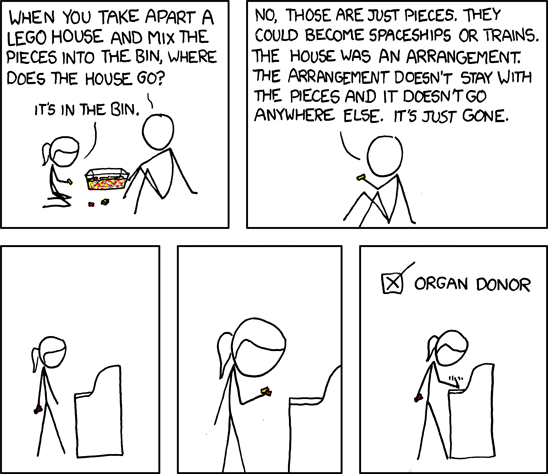
When, not if, but when my aneurysm blows and I infarct at least one half of my brain, do this:

Take what you can. I don't care how tricky or political or corrupt the system is, the ends justify the means in this case. Use my kidneys, my heart, my cruddy lungs, whatever.

Donate the rest to a medical school. They can have fun studying my muscles and my skull, if nothing else.

Compost the rest out in the back yard, and plant a garden over it. In the high summer, when the produce is ready to pick, go out and grab a tomato off the vine, polish it on your shirt, and bite into it. My epitaph will read, "That Jo! She was one heck of a tomato!"

Sunday, November 15, 2009

Tales from the CVCCU

As part of our training, we interns have to go to the cardiovascular CCU at Holy Kamole. They deal with things there that, thank Frog, I will never have to see. Bone-marrow transplants gone wrong I can handle; neurological disorders hold no sway in my nightmares. But heart and lung and kidney and what-have-you transplants? Are the stuff of horrid, horrid dreams.

I am meant to do a thorough neuro exam every hour. I am meant to understand dermatomes, Brown-Sequard syndrome, and incomplete cord transections. I am not meant to handle eight vasopressor drips on one patient.

So it was with fear and trembling that I got to the unit to follow an experienced CV nurse. The patient she had was one of those who requires two nurses: every once in a while, you'll see a one-on-one (for instance, if somebody's undergoing continuous, slow dialysis), but two-to-ones are very, very rare.

What does it take to be a two-to-one patient?

Let's start with a rare genetic disorder that only about a thousand people in the world have, and make it one that only, say, vegetarian left-handed expatriate Iranians living in Hungary are prone to. (Of *course* that isn't the real disorder. Do you think I'd violate HHIIPPAAA that way?) Be certain that your patient fits none of those categories.

Add on the necessity of not one, not two, but three--so far--solid organ transplants over the lifespan of this particular patient. If you can make one of them a re-transplant, so much the better.

Make sure that that weird genetic disorder isn't diagnosed until after the first solid-organ transplant; that way, you'll stand a good chance of ruining whatever organ you transplant the first time with the complications of said genetic disorder. (As an added bonus, make sure that the patient's sisters and brother all find out that they're carriers of this nasty disease, and fuck their brains, their future plans, and their reproductive decisions up as a result.)

If you can manage a rare-but-dangerous viral infection, tack that on as well.

Oh, and be sure you put in for an order of adult respiratory distress syndrome, with a side of sepsis.

What you end up with is an absolutely beautiful young woman on a ventilator, with a midline incision that runs from belly to brisket, six pressor drips, and very little chance of ever waking up.

I left my job at Planned Parenthood the day that a twenty-seven year old woman came in with her pregnant thirteen-year-old daughter. The woman asked me if I expected her to cry over her daughter's being pregnant; the idea that any other possibility would present itself showed me such a huge gulf between her experience and mine that I could no longer deal with the disconnect. I had thought that that was as bad as it got.

Until I saw a smart, funny, gorgeous girl of twenty-three hooked up to hinty-bazillion machines, all of which were dedicated to keeping her body alive until, frankly, her parents and siblings could work up the courage to say goodbye.

The day wasn't made any easier by the fact that I had known her before, years ago, when she came in to our floor and ended up being diagnosed with that crazy genetic disorder. I thought then that she wouldn't make it to nineteen; I was wrong. Her parents showed me the pictures of her on the campaign trail for Obama, the snapshots of her hanging out with Sasha and Malia and Michelle and Barack. They told me about how she felt so strongly about particular issues up for debate in the Texas Legislature that she disregarded the advice of her doctors and went to testify as an advocate for battered women, how she ignored the symptoms of organ rejection in order to go to a conference on providing health care to uninsured people. There was a framed picture of her getting her Master's degree on the table by the bed.

And two pumps with three channels each, a balloon pump, a ventilator, and three pages of IV drips that had to be administered at exactly the right times.

I guess it bears mentioning here that her parents and older sister recognized me the minute I walked into the room and called me by name. It sucks when people you have to disappoint remember you so well.

We walk a fine line, nurses and doctors. On the one hand--and I think this is more true of nurses than of doctors, except in rare cases--we gain a degree of intimacy with families that would be inconceivable in most settings. On the other, we have to maintain that professional distance that allows us to advocate, to educate, to break bad news.

Sometimes, that last is easy. You can manage, even with people you see more than once or twice, to keep your distance. Sometimes it's very, very hard. And sometimes, despite your best intentions, you fail completely at being a detached professional person.

I was not the person who extubated her. I was the person, though, who turned off all of the drips, and hung the morphine up, and titrated it so that she didn't show any distress, and who laid my useless expensive stethoscope against a chest in order to hear what wasn't there.

I was the one who had to look across her body and tell her parents and her brother and her sisters, "She's gone, now."

And I was the one who broke every professional boundary imaginable by standing in her room with them and crying over the loss of a reasonable, decent, driven young person who had bad, bad genetic luck.

In a way, I'm glad it was me. I was there when she found out she had this thing wrong with her that would shorten her life; I was there when she told her parents, quite matter-of-factly, "This won't change any of the plans I've got." My ability to translate medicalese into English eased their transition from normal family to family with dangerous medical condition; it helped that I could put things in every-day language and thus calm some of their fears.

But even two nurses, six drips, a balloon pump, and all the translation talent in the world can't save somebody, sometimes.

Still, I'm really, really glad I was there. I'm glad I got to see what she'd done.

I'm glad I got to say goodbye.

Wednesday, November 05, 2008

When the code doesn't work

Everybody loses patients. Everybody remembers the patients they lost--maybe not by name, or even by face, but you remember. Every patient who dies leaves a little hole in you.

The first one is the worst for most people. And it's bad enough when it's a patient who's been shifted to comfort care; it's worse when it's a failed code. When you walk into a room to find a person, who was fine half an hour or an hour before, is just plain dead, it's shocking. Codes are shocking, too, in their violence and their (usual) pointlessness.

That happened to a coworker of mine the other day. Her patient had been fine and stable and cheerful all shift long and had laid down to take a nap near the end of the shift. He was scheduled to go home the next day. When she made her last put-'em-to-bed rounds of the day, she found him not breathing, not pulsing, not responding. Just plain dead.

And we coded and coded and coded and it had the predictable result.

So what do you do when a code fails?

Well, first, you allow yourself a little freak-out. If you're lucky enough to work where I do, the other nurses on the floor will pick up the slack for ten minutes while you lock yourself in the bathroom and flip your lid. If you're not lucky that way, you'll have to do it while you fill out paperwork and call the eye harvester folks.

Then you figure out what went wrong. In most situations, absolutely nothing anybody could've done would've prevented the death. Short of overdosing a patient on medications or giving them the wrong blood or shoving a tube feed into an arterial line, dying is not something we have a whole lot of input into. Still, it's helpful to think about what led up to your patient's stopping breathing, if only because it'll reassure you that you didn't screw up.

Then you deal with your other patients. It's easy to forget, in the aftermath of a code, when you're overwhelmed with emotion and paperwork, that there are four or five or six other people that are still alive that are depending on you. 

Finally, at the end of the shift, you go home. 

Think about your patient. Raise a toast to 'em, if that's how you roll. Talk to your partner. Hug your kids or your dog or your cat. Roll into bed, with or without the general anesthetic of your choice onboard, and remember that every shift is a new one.

Everybody dies. Some of us die more easily than others, and in better situations. There is not a damned thing you, as a nurse, can do to prevent a death if it's gonna come anyhow. The best you can do is learn from the situation if it's less-than-ideal and use that knowledge to improve the lot of the next folks you take care of.